
When food crops become ornamentals: Insights from the Western Pacific
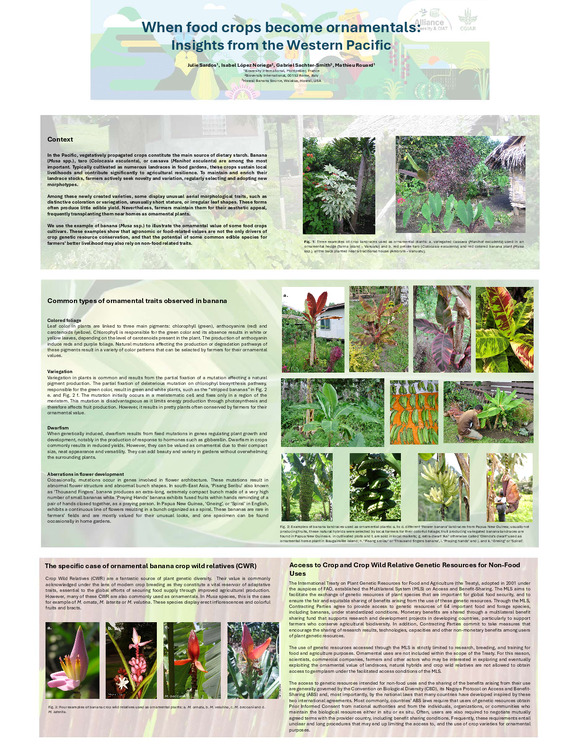
In the Pacific, vegetatively propagated crops constitute the main source of dietary starch. Banana (Musa spp.), taro (Colocasia esculenta), or cassava (Manihot esculenta) are among the most important. Typically cultivated as numerous landraces in food gardens, these crops sustain local livelihoods and contribute significantly to agricultural resilience. To maintain and enrich their landrace stocks, farmers actively seek novelty and variation, regularly selecting and adopting new morphotypes.
Among these newly created varieties, some display unusual aerial morphological traits, such as distinctive coloration or variegation, unusually short stature, or irregular leaf shapes. These forms often produce little edible yield. Nevertheless, farmers maintain them for their aesthetic appeal, frequently transplanting them near homes as ornamental plants.
We use the example of banana (Musa ssp.) to illustrate the ornamental value of some food crops cultivars. These examples show that agronomic or food-related values are not the only drivers of crop genetic resource conservation, and that the potential of some common edible species for farmers’ better livelihood may also rely on non-food related traits.