
From web to radio: Leveraging user-centered water and pasture monitoring for climate resilience in Borana Pastoral Communities
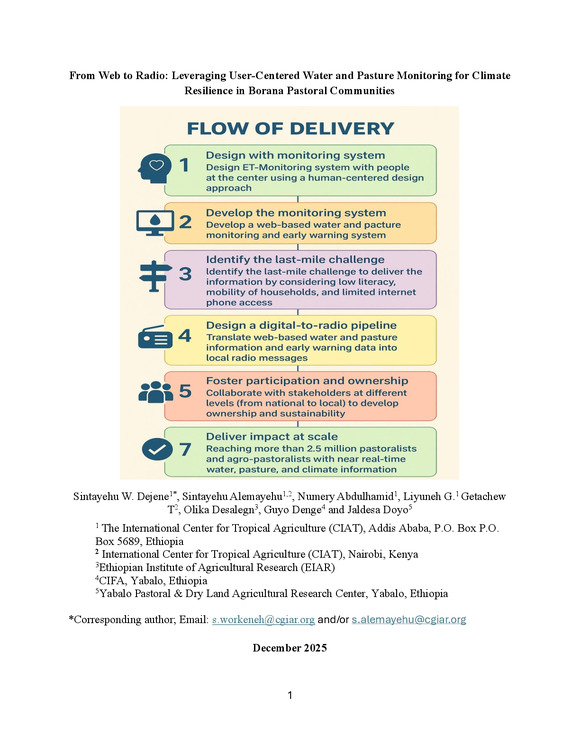
Pastoral and agro-pastoral livelihoods in the Borana Zone of southern Ethiopia are increasingly threatened by recurrent droughts, erratic rainfall, and growing competition over scarce water and pasture resources. While near real-time monitoring and early warning systems can significantly enhance climate-informed decision-making, their effectiveness depends on reaching highly mobile communities with limited literacy, internet access, and digital connectivity. To address this gap, the Alliance of Bioversity International and CIAT, in collaboration with the Ethiopian Institute of Agricultural Research (EIAR) and the Ministry of Agriculture, developed a user-centered Water and Pasture Monitoring, Prediction, and Early Warning System (ET-Monitoring) that integrates satellite data, local observations, and predictive modeling to deliver actionable information on water, pasture, and climate conditions.
Building on a human-centered design process, pastoral communities identified local radio as the most trusted, inclusive, and accessible communication channel. This insight led to the creation of a digital-to-radio pipeline, translating complex scientific outputs into simple, localized advisories broadcast in Afan Oromo. The resulting HORA Radio Spot Program, implemented with the Oromia Broadcasting Network (Yabello branch), delivers near real-time water and pasture updates, seasonal climate forecasts, and early warning messages directly to pastoral households.
Since its launch, HORA has aired six interlinked episodes covering seasonal climate outlooks, early warning use, community information centers, and the integration of indigenous knowledge with scientific data. Key features include gender-responsive broadcasting schedules, culturally grounded messaging, participatory call-in sessions, and conflict-sensitive framing. Through radio broadcasts and complementary dissemination pathways, HORA has reached more than 500,000 pastoralists and agro-pastoralists, enabling improved migration planning, reduced livestock losses, more sustainable resource use, and enhanced conflict prevention. The Borana experience demonstrates how combining digital monitoring systems with trusted local media can effectively bridge the last-mile information gap and strengthen climate resilience in pastoral settings.