
Validation of resilient and drought adapted forage hybrids and cultivars in Mali
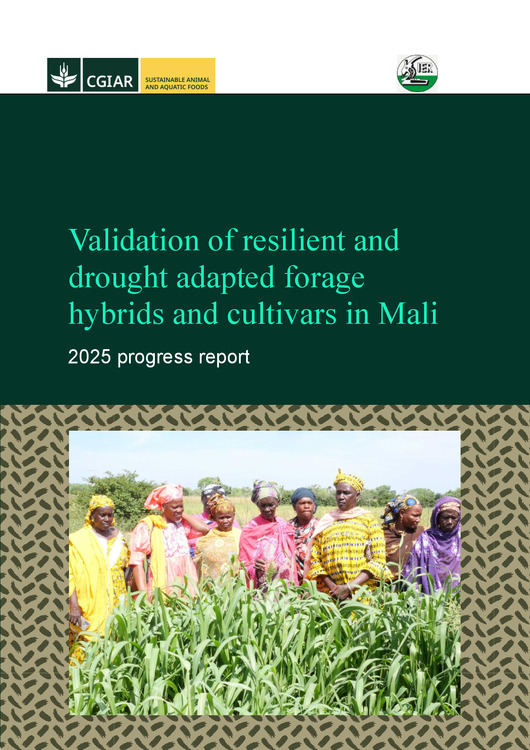
This 2025 progress report documents multi-site validation of drought-adapted forage grasses in Mali to strengthen feed availability and resilience for livestock systems. Trials combined an on-station experiment at Sotuba (Bamako) with on-farm evaluations in Barouéli (Ségou) and Farakala (Sikasso). At Sotuba, 13 forage grasses (including Urochloa (Brachiaria) cultivars and hybrids, Megathyrsus maximus (Panicum maximum) cultivars and Andropogon gayanus) were assessed in their third year under a randomized design with four replications. Seasonal rainfall totalled 1,043 mm, concentrated in August–September, with a clear dry season. Measurements included rainfall distribution, plant density, tiller number, plant height, biomass production, and derived carrying capacity (tropical livestock units, TLU). Significant varietal effects were observed for plant density (ANOVA p = 0.02; 47,500–62,500 plants/ha), tillering (p = 0.003; highest in Urochloa hybrids “Camello” and “Mestizo”), and plant height (p = 0.008; tallest Andropogon gayanus at 296 cm; shortest U. hybrid “Camello” at 87 cm). Biomass yield varied (p = 0.02), ranging from 6.36 t DM/ha to 25.85 t DM/ha. Top performers were A. gayanus (25.85), M. maximus “Mombasa” (15.53), and U. brizantha “Marandu” (15.16). Estimated three-month dry season carrying capacity ranged from 11.3 to 46.0 TLU/ha, indicating substantial potential to reduce feed shortages. On-farm trials showed strong site-by-variety interactions: Barouéli generally produced higher biomass than Farakala. Notably, M. maximus “Mun River” reached 30.46 t DM/ha in Barouéli, while U. hybrid “Cobra” peaked at 15.86 t DM/ha in Farakala. Overall, the results identify promising, environment-specific forage options to support climate-resilient forage production and guide scaling decisions for Sahelian and Sudanian agroecologies in Mali.