
Trust, support, and knowledge sharing: The role of social capital in responsible scaling of climate-smart agriculture
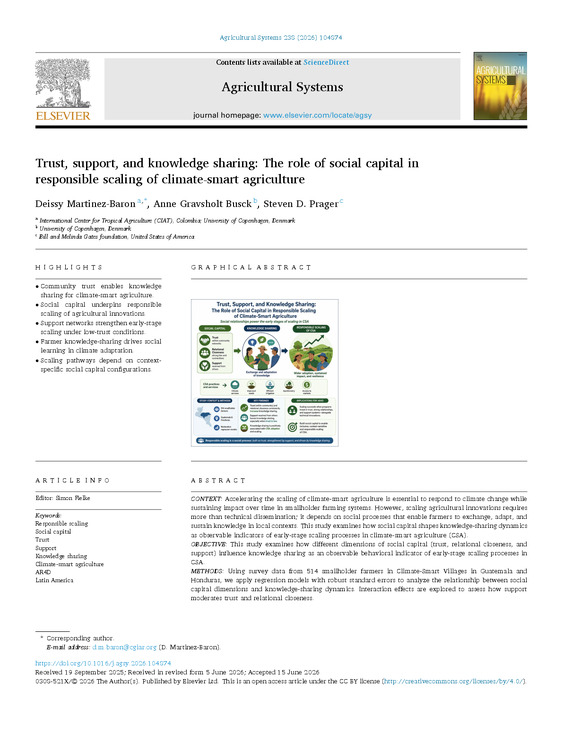
CONTEXT Accelerating the scaling of climate-smart agriculture is essential to respond to climate change while sustaining impact over time in smallholder farming systems. However, scaling agricultural innovations requires more than technical dissemination; it depends on social processes that enable farmers to exchange, adapt, and sustain knowledge in local contexts. This study examines how social capital shapes knowledge-sharing dynamics as observable indicators of early-stage scaling processes in climate-smart agriculture (CSA).
OBJECTIVE This study examines how different dimensions of social capital (trust, relational closeness, and support) influence knowledge sharing as an observable behavioral indicator of early-stage scaling processes in CSA.
METHODS Using survey data from 514 smallholder farmers in Climate-Smart Villages in Guatemala and Honduras, we apply regression models with robust standard errors to analyze the relationship between social capital dimensions and knowledge-sharing dynamics. Interaction effects are explored to assess how support moderates trust and relational closeness.
RESULTS AND CONCLUSIONS Trust and relational closeness within community networks are consistently positive and significant predictors of knowledge sharing, while trust in organizations shows limited influence. Support received from others positively influences knowledge sharing, particularly in low-trust contexts, where it compensates for weak relational ties. Interaction effects reveal diminishing marginal returns of support as trust increases, indicating a substitution effect. Adoption of CSA practices is also positively associated with knowledge sharing. The findings demonstrate that early-stage scaling emerges from relational processes embedded in social networks. By linking social capital to knowledge-sharing dynamics, the study provides an empirical basis for operationalizing responsible scaling as a socially embedded process. These insights contribute to a more systemic understanding of how inclusive and context-sensitive scaling pathways can be enabled in agricultural systems.
SIGNIFICANCE This paper advances responsible scaling research by showing how social capital can be empirically linked to observable knowledge-sharing behaviors in climate-smart agriculture. The findings offer practical guidance for AR4D programs by highlighting that scaling strategies should invest not only in technical innovations, but also in the trust, relational closeness, and support structures that enable farmers to adapt and sustain those innovations in local contexts.