
Transect food systems profile in Southeast Asian countries: An Analysis of Cambodia, Vietnam, and the Philippines.
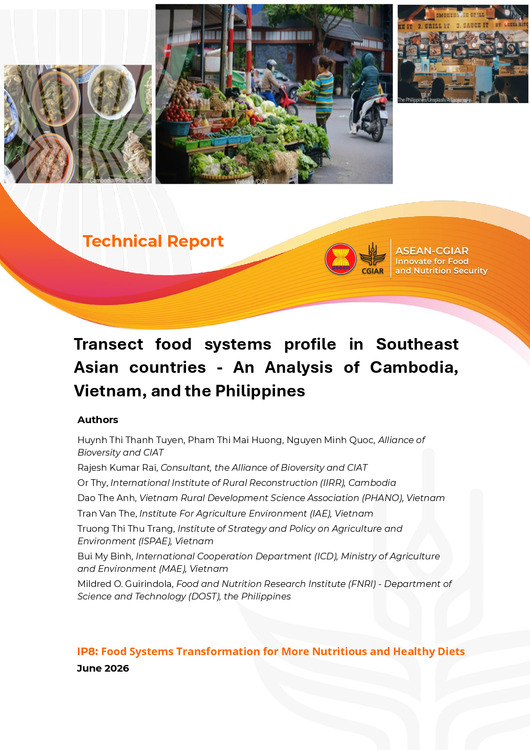
Southeast Asia’s food systems are undergoing profound socioeconomic and demographic metamorphosis, driven by rapid urbanization, rising middle-class incomes, and deepening integration into global trade. This technical report, Transect Food Systems Profile in Southeast Asian Countries: An Analysis of Cambodia, Vietnam, and the Philippines, examines how these dynamics are reshaping food supply chains, food environments, consumer behavior, and food system outcomes across three countries positioned at different stages of transformation. Using the High-Level Panel of Experts (HLPE) food systems typology framework, the analysis situates the key food system elements of each country within the relevant typology.
Drawing evidence from multiple indicators, the food systems of the three ASEAN countries exhibit characteristics corresponding to different types. However, these alignments are not consistent across all food system elements. Cambodia largely reflects the features of a traditional food system, although certain aspects show emerging tendencies toward mixed and modern forms. By contrast, Vietnam and the Philippines demonstrate more differentiated configurations. Vietnam’s supply chains are comparatively advanced, reflected in export-oriented agri-food industries, intensive use of agricultural inputs, and the rapid expansion of commercial value chains. Nevertheless, its food environment and consumer behaviors remain mixed, with traditional wet markets coexisting alongside rapidly growing modern retail channels. The Philippines, on the other hand, displays supply chains that combine traditional smallholder production with industrialized distribution networks, while its food environment leans more strongly toward modern patterns, characterized by high retail concentration, a pervasive convenience and fast-food culture, and the highest per capita retail value of ultra-processed foods among the three countries.
The evidence on food system outcomes suggests that as Southeast Asian food systems modernize, they trade one set of challenges for another. Cambodia’s food system outcomes are in line with characteristics of traditional systems, including high agricultural employment and subsistence-oriented production, but are hindered by significant post-harvest losses and high levels of food insecurity. Vietnam's mixed food systems have successfully leveraged intensive inputs and research & development to boost productivity and dietary diversity, yet this transition has come at a high environmental cost, including high water use, greenhouse gas emissions, and land use changes. The Philippines' mixed-to-modern systems showcases an industrially mature supply chain and high digital connectivity, but it is plagued by a "paradox of progress": staggering adult overweight rates and a food environment where healthy diets are unaffordable for more than 40% of the population, while also retaining traditional-system outcomes such as high stunting rates, reflecting persistent undernutrition alongside the double burden of modern dietary challenges.
Across the transect, the analysis reveals that modernization does not automatically translate into improved nutritional outcomes. Instead, food system evolution often shifts the burden from calorie insufficiency and micronutrient deficiencies in traditional systems to diet-related NCDs and environmental degradation in modernizing systems.
The report concludes that Southeast Asia requires differentiated yet coordinated strategies. Traditional systems need foundational investments in infrastructure and dietary diversification; mixed systems must balance food safety and productivity with sustainability and nutrition safeguards as well as limit the rise of ultra-processed food consumption; and modern systems must address both burdens of high stunting and obesity by improving healthy diet affordability, regulating ultra-processed foods, and building climate-resilient logistics infrastructure. A regional transformation pathway should prioritize climate resilience, healthy diet affordability, gender inclusion, and sustainable production to ensure that food system modernization supports nutrition, environmental sustainability, and social equity.