
Technical Report : Xam Xamu Suuf. Precision fertilizer recommendations and water management technologies targeting web applications
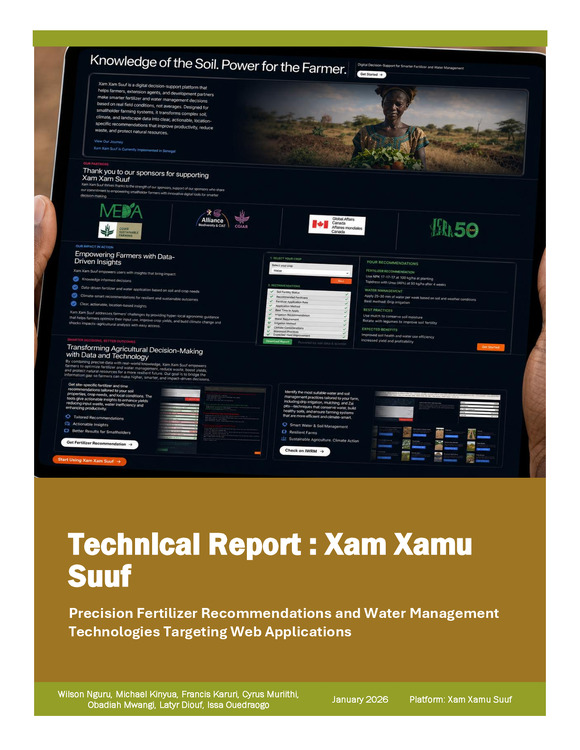
In the face of increasing climate variability and growing pressure on agricultural systems in Senegal, farmers and decision-makers need smarter, faster, and more localized solutions. Xam Xamu Suuf responds to this need by offering a dynamic, digital decision-support platform designed to advance site-specific fertilizer recommendation and soil health. This report presents the development, validation, and deployment of the platform, which brings together two complementary web-based tools: a Fertilizer Recommendation Tool and an Integrated Water Resource Management Targeting Tool. By combining data, science, and local context, these tools deliver location-specific, actionable guidance to farmers, extension service providers, educators, and development practitioners, helping them make better decisions, optimize resource use and build more resilient farming systems.
Why does this matter?
Smallholder farmers continue to face persistent challenges such as limited access to reliable agronomic advisory, increasing climate variability, and inefficient use of fertilizers and water resources leading to reduced productivity, and weakened long-term sustainability.
Xam Xamu Suuf was developed to close this critical gap. By leveraging geospatial technologies and open-access environmental datasets, the platform transforms complex soil, climate, and topographic data into practical, easy-to-use recommendations thus bridging the divide between science and on-the-ground decision-making.
The tools were developed using a novel, scalable web architecture, combining a mobile-friendly front end with a robust back end capable of handling spatial and attribute data. Key datasets include high-resolution global soil information from ISRIC, climate variables from WorldClim and ANACIM, and elevation-derived slope data from USGS sources. These inputs support algorithms that generate fertilizer recommendations based on nutrient availability and crop requirements, as well as targeted suggestions for appropriate land and water management technologies such as drip irrigation, terracing, and Zai pits.
Validation was conducted through an extensive field engagement in Tambacounda and Sédhiou in 2024, complemented by a national stakeholder workshop held in Dakar in 2025. Participants included farmers, extension officers, agronomists, and representatives from national and international institutions such as ISRA, ANCAR, ANACIM, CIAT, MEDA, and the National Institute of Soil Science (INP). Stakeholder feedback confirmed the tools’ relevance, usability, and technical soundness, while identifying opportunities for improvement, particularly in data localization, crop specificity, and user support.
The platform is designed for broad accessibility, requiring no user login and functioning effectively under low-bandwidth conditions. Core features include geolocation-based recommendations, manual input of field or laboratory soil data, PDF export of results, and option to request field extension support. Interfaces are currently available in English and French, with potential for expansion into local languages.
Despite these strengths, the platform faces several limitations, including reliance on proxy datasets, limited crop and technology coverage, variable digital access in rural areas, and the need for sustained institutional ownership. Addressing these challenges presents clear opportunities for future investment, including data enhancement, offline functionality, expanded training programs, and deeper integration into national extension systems.
Xam Xamu Suuf is now functionally ready for wider deployment and scale-up. It is hosted and deployed under the domain https://www.xamxamsuuf.com/. With continued collaboration among research institutions, extension services, development partners, and the private sector, the platform offers a strong foundation for improving resource efficiency, supporting climate adaptation, and enhancing decision-making among smallholder farmers. Xam Xamu Suuf represents a practical, scalable, and evidence-based digital public good with significant potential to contribute to sustainable agricultural transformation in Senegal and beyond.