
Strengthening community resilience in the Sahel and Casamance regions of Senegal: Evidence from a quasi-randomized controlled trial of the AVENIR project on women and youth economic empowerment in Sédhiou and Tambacounda
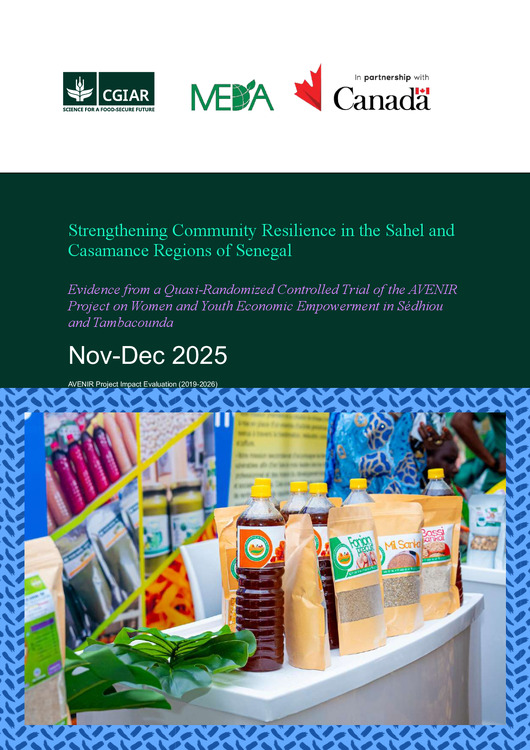
This study presents the impact evaluation of the AVENIR project, implemented to strengthen the resilience and livelihoods of rural households in Senegal through the promotion of agrinutrition, climate-smart agriculture (CSA), climate information services (CIS), and improved water resource management (IWRM). Using a quasi-experimental Difference-in-Differences (DiD) design, the analysis compares households in intervention and comparable non-intervention areas over time. The dataset comprises approximately 1,800–1,900 households, enabling robust estimation across multiple welfare and resilience dimensions. Econometric approaches include fixed-effects models, generalized linear models (probit), mixed-effects models, and negative binomial models, complemented by robustness checks and heterogeneous impact analysis by gender and age.
Results indicate that the AVENIR project significantly improved household food security and dietary diversity, with beneficiary households exhibiting higher dietary diversity and reduced food insecurity. Access to and use of climate information services increased by 21–27 percentage points, underscoring the effectiveness of interventions targeting climate-informed decision-making. Adoption of CSA practices rose by approximately 38 percent, while uptake of improved water management practices increased by 12–16 percentage points.
Heterogeneity analysis reveals differentiated impacts across demographic groups: younger women (18–34) showed the strongest gains in climate adaptation practices, while older women (35+) experienced greater improvements in food security, wealth, and resilience capacity. Younger men benefited primarily in food security and economic outcomes.
These findings highlight the effectiveness of integrated resilience interventions that combine climate information, agricultural innovation, and natural resource management. Policy implications emphasize the need to scale such approaches, strengthen access to climate information systems, and adopt gender-responsive and youth-inclusive strategies to enhance resilience and sustainable agricultural development in climate-vulnerable regions.