
Scoping review report: Assessing Sechium edule (Cidra papa) food systems in Colombia
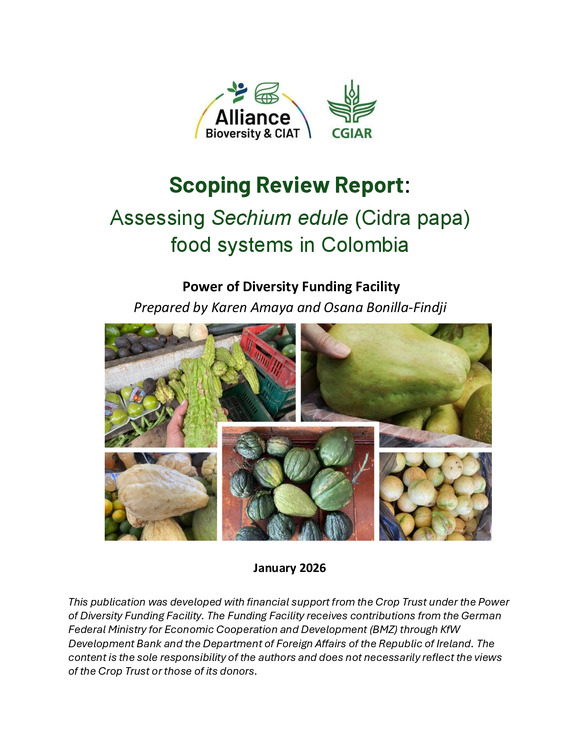
Objective: The aim of this scoping review is to systematically identify, compile, and analyze existing evidence on Sechium edule—commonly known in Colombia as cidra, cidra papa or guatila—to characterize its supply chain, food environment dimensions, consumption patterns, and its documented or potential contributions to food security, nutrition, health, income and livelihoods, climate resilience, sustainability, and social inclusion.
Introduction: Sechium edule is a culturally significant, nutrient rich cucurbit native to Mesoamerica and widely cultivated across several Colombian departments including Cauca, Nariño, Antioquia, Cundinamarca, Boyacá, Santander, and Valle del Cauca. Despite its versatility, year round fruiting, and resilience under low input conditions, the crop remains underutilized, stigmatized as a “poor people’s potato,” and embedded mostly in informal, subsistence oriented systems with limited market integration. Its nutritional attributes—fiber, vitamins, antioxidants, and minerals—highlight substantial potential for contributing to healthier diets and functional foods, while its agronomic adaptability positions it as a strategic species for diversified and climate resilient food systems.
Inclusion criteria: Eligible documents referred explicitly to Sechium edule (including synonyms, i.e., its common names such as cidra, guatila, cidra papa, chayote), were focused on Colombia, published mostly from 2005 onward, except for four documents, and written in Spanish. These included studies addressed value/supply chains, food environment dimensions, market or policy aspects, and/or outcomes related to nutrition, food security, health, livelihoods, climate resilience, sustainability, or inclusion. Document types spanned peer reviewed articles, theses, reports, policy documents, books/chapters, and technical materials. Studies lacking methodological rigor or unrelated to food system topics were excluded.
Methods: Searches were implemented across major peer-reviewed databases (PubMed, Scopus, SciELO, ScienceDirect, Web of Science) and extensive grey literature sources (CGSpace, FAO, ECHO, IICA, Agrosavia, university repositories, and governmental platforms such as UPRA/EVA). Boolean combinations of species specific and food system terms guided query construction. Records were organized and screened using CADIMA, enabling systematic title/abstract and full text screening following PRISMA ScR principles. A standardized extraction template captured data on geographic scope, value chain stages, stakeholders, food environment attributes, and outcomes of interest.
Results: A total of 65 studies met all eligibility criteria. Evidence shows that Cidra production in Colombia is dominated by small scale, low input systems, using informal seed practices, and concentrated in diversified plots where the crop plays a complementary role. Postharvest losses are generally minimal due to staggered harvesting and robust fruit physiology, but vivipary, mechanical damage, and temperature sensitivity limit storage and long distance commercialization. Supply chains are predominantly short and informal, with limited wholesale presence, strong regional varietal preferences, and gendered micro processing roles—particularly among women. Food environment findings highlight frequent mentions of availability and desirability, but scarce evidence on affordability, convenience, and consumption constraints. Value addition opportunities—flours, pectin, beverages, functional foods, snacks, cosmetics—show high potential but remain pilot scale due to technological, regulatory, and investment barriers. Outcomes demonstrate contributions to nutrition, health, income/livelihoods, and inclusion, but limited evidence on climate resilience, nutritional status, or policy impacts. Official data reveal the crop’s marginal presence in agricultural statistics and fluctuating market volumes and prices across wholesale markets.
Conclusion: Cidra is a nutritious, culturally embedded, resilient, and underutilized species with strong potential to enhance dietary diversity, promote inclusive livelihood opportunities, and contribute to climate adapted food systems in Colombia. However, its broader utilization is constrained by informal seed systems, scarce production, harvesting, post-harvesting, storage and transportation management practices, low market visibility, stigma, weak standardization, limited value addition capacity, and uneven policy attention. Strengthening seed/propagation systems, enabling women led processing enterprises, supporting technological upgrading, improving market differentiation, and generating evidence on nutritional and agronomic performance are critical next steps to unlock the crop’s potential.