
Scoping review report: Assessing peach palm -Bactris gasipaes (Chontaduro) food systems in Colombia
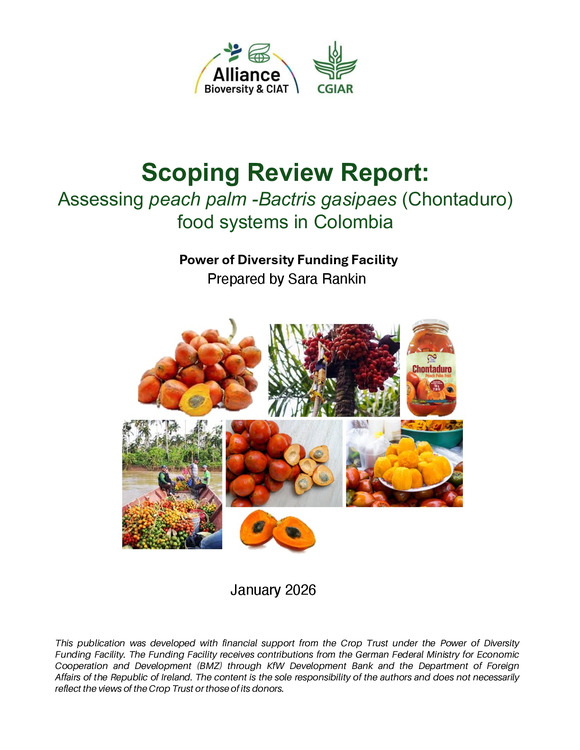
Objective: The aim of this scoping review is to systematically identify, compile, and analyze existing evidence on Bactris gasipaes—commonly known in Colombia as chontaduro or peach palm—to characterize its supply chain, food environment dimensions, consumption patterns, and its documented or potential contributions to food security, nutrition, health, income and livelihoods, climate resilience, sustainability, and social inclusion.
Introduction: Chontaduro (Bactris gasipaes) is a culturally significant, nutrient-dense palm fruit native to tropical Latin America and widely produced and consumed in Colombia, particularly in the Pacific region. With a long history of domestication and strong links to Afro-descendant food cultures, the crop plays an important role in local diets, seasonal food security, and informal economies. Its high energy density, lipid and carotenoid content, and adaptability to diversified tropical agroecosystems position chontaduro as a species with strong potential to contribute to healthier diets, inclusive value chains, and biodiversity-friendly food systems. Despite these attributes, chontaduro remains largely underutilized beyond traditional markets, embedded in informal and low-visibility supply chains, and weakly integrated into formal policy, market, and regulatory frameworks.
Inclusion criteria: Eligible documents referred explicitly to Bactris gasipaes (including common names such as chontaduro or peach palm), focused on Colombia or included Colombia within a regional analysis, were published between 1995 and 2025, and written in Spanish or English. Included studies addressed one or more food system dimensions, including production, post-harvest handling, processing and value addition, markets, food environments, governance, or outcomes related to nutrition, food security, health, livelihoods, climate resilience, sustainability, or inclusion. Document types included peer-reviewed articles, student theses, technical and
research reports, policy-relevant documents, books or book chapters, and other grey literature. Publications lacking methodological rigor or not related to food-system topics were excluded.
Methods: Searches were conducted across peer-reviewed databases and a wide range of grey-literature sources, including CG Space, Dialnet, Google Scholar, university repositories (e.g., Universidad Nacional de Colombia, Universidad del Valle), AGROSAVIA, and governmental and institutional platforms. Boolean combinations of species-specific terms (e.g., chontaduro, Bactris gasipaes) and food-system-related keywords (e.g., value chain, processing, markets, consumption, nutrition) guided the search strategy. Records were screened following PRISMA-ScR principles, and a standardized extraction matrix was used to capture data on geographic
focus, methods, value chain stages, food environment dimensions, governance aspects, and outcomes of interest.
Results: A total of 75 documents met the eligibility criteria. The evidence base is highly uneven, with strong concentration on processing technologies, nutritional composition, value addition practices, sustainability narratives, and quality attributes, and much weaker coverage of seed systems, economic performance, consumer-side constraints, governance, and measured nutrition and health outcomes. Chontaduro production is dominated by small-scale, low-input systems integrated into diversified agroecosystems. Supply chains are predominantly short, informal, and proximity-based, with limited coordination, strong dependence on intermediaries, and high seasonal variability. Processing research highlights substantial technological potential—particularly for flours, oils, carotenoid-rich extracts, and functional foods—but most innovations remain at laboratory or pilot scale with limited adoption. Food environment evidence shows high local availability and cultural desirability, but constraints related to seasonality, low convenience, inconsistent quality, and weak regulatory integration, especially in urban and formal retail settings. Across outcomes, studies indicate positive contributions to seasonal food security, dietary diversity, income diversification, sustainability, and inclusion, particularly among Afro-descendant communities, while direct evidence on nutritional status, health impacts, climate resilience, and policy effects remains limited.
Conclusion: Chontaduro is a nutritious, culturally embedded, and agroecologically adapted species with significant potential to contribute to inclusive, sustainable, and resilient food systems in Colombia. Its continued underutilization is driven not by intrinsic crop limitations, but by systemic gaps in seed systems, market coordination, processing adoption, food environment integration, and policy recognition. Addressing these challenges will require integrated, outcome-oriented, and equity-sensitive approaches that align research, governance, and value chain development while safeguarding the cultural foundations that sustain chontaduro production and consumption.