
Quantitative gender analysis country report, Madagascar: Building Equitable Climate Resilient African Bean and Insect Sectors (BRAINS) Project
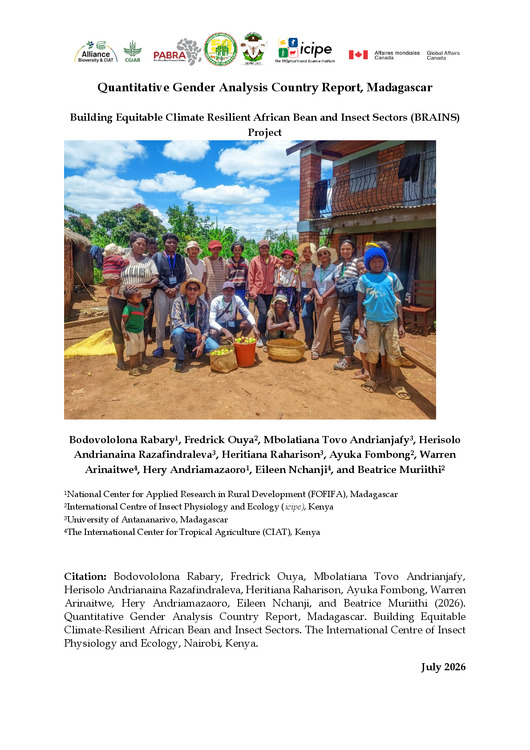
This quantitative baseline analysis was conducted as part of the Building Equitable Climate-Resilient African Bean and Insect Sectors (BRAINS) effort in designated districts across the Analamanga, Itasy, and Vakinankaratra regions of Madagascar. The study assessed gender-specific participation, access to productive resources, climate vulnerability, adaptation techniques, and involvement in value chains for common beans, insects, and fruit trees among smallholder farmers. A total of 362 farmers, including 64 women and 298 men, were interviewed using a gender-responsive household survey. The results demonstrate that agriculture is pivotal to rural livelihoods and food security, yet farming systems are increasingly influenced by climate variability, notably erratic rainfall, prolonged droughts, floods, diminishing yields, pests, and diseases. Bean and fruit tree enterprises have become significant livelihood activities, and respondents demonstrated considerable awareness of weather and climate information services.
The study uncovered substantial gender inequalities in access to productive resources, land ownership, literacy, mobile phone ownership, and market engagement. Male farmers acquired larger land areas, achieved higher production outputs, and engaged more extensively in commercial markets, whereas female farmers focused on seed conservation, household consumption oversight, and adaptation practices, including crop rotation, reforestation, and diversification. Bean production was primarily governed by informal seed systems, with most farmers relying on self-preserved seeds or local markets. In fruit tree operations, mangoes, peaches, and avocados were the predominant fruits cultivated, despite relatively low levels of commercialisation. Women were more vulnerable to climate-related challenges, notably droughts, declining yields, pests, and water management limitations, indicative of enduring structural inequities that affect adaptive capacity and resilience.
Despite these challenges, the findings reveal significant opportunities to enhance climate resilience and foster inclusive agricultural development. Farmers recognised climate-resilient cultivars, ecosystem restoration, irrigation infrastructure, technical education, and improved water management as essential adaptation strategies. Most respondents considered current adaptation techniques effective; however, significant deficiencies in resources, technologies, extension assistance, and market access persist. The report emphasises the need for gender-responsive initiatives that enhance women's access to productive resources, climate information services, quality seed systems, and markets, while advancing climate-smart agriculture, inclusive decision-making, and sustainable livelihood transformation within the BRAINS project regions in Madagascar.