
Qualitative gender analysis country report, Ethiopia. Building Equitable Climate Resilient African Bean and Insect Sectors (BRAINS) Project
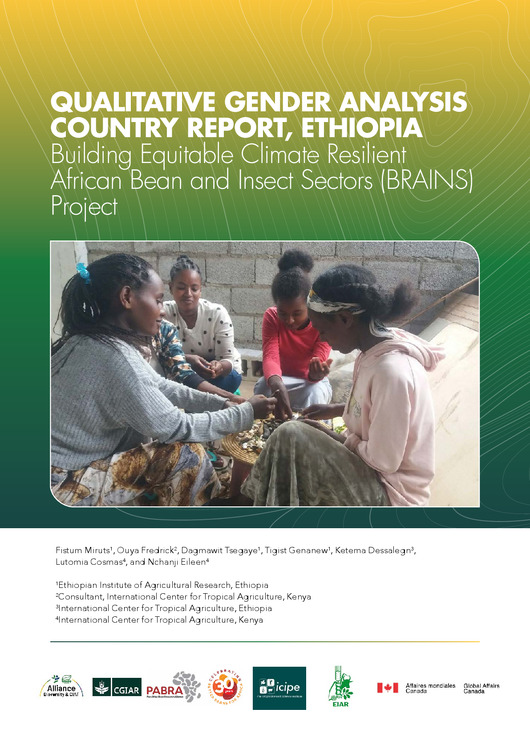
This study presents findings from a qualitative gender analysis conducted in Ethiopia as part of the Building
Equitable Climate Resilient African Bean and Insect Sectors (BRAINS) project. The study analyses gender
dynamics, climate change effects, and livelihood options across integrated value chains for common beans,
fruits, and beneficial insects (bees and vermicompost). The analysis collected data through age and gender
disaggregated focused group discussions with farmers and key informant interviews that targeted persons with
special needs (disability) and/or vulnerable groups and entrepreneurs from the common bean, insect and fruit
tree value chains in the five regions. The analysis is grounded in Ethiopia’s agricultural context, characterised
by smallholder farming, where gender disparities markedly influence access to resources, productivity, and
resilience outcomes. Based on the study objectives, the data were substantially analysed using content and
thematic analysis approaches.
Research reveals that agriculture serves as the primary livelihood source, contributing approximately 70 to 80% of
household income in the studied areas, with minimal diversification into livestock and non-agricultural industries.
Farmers exhibit considerable expertise in common bean cultivation but encounter significant deficiencies in
incorporating fruit and beneficial insect systems. Specifically, restricted technical ability, insufficient awareness of
vermicomposting, and socio-cultural attitudes, such as aversion to worms, impede uptake despite acknowledged
advantages for soil fertility and productivity. These findings correspond with extensive research indicating a
poor adoption of integrated and climate-smart farming techniques in Ethiopia, attributed to knowledge and
institutional limitations.
Gender roles are essential in influencing participation and decision-making within value chains. Although
several households indicate collaborative decision-making, men persist in exerting dominance over productive
resources and marketing choices. Women significantly participate in production, processing, and household
nutrition; yet they encounter structural obstacles, such as restricted access to land, credit, and extension services.
These findings align with national studies indicating enduring gender disparities in agricultural output and
resource accessibility in Ethiopia. Youth involvement is apparent but predominantly restricted to labour-intensive
positions, with minimal participation in decision-making or entrepreneurial activities.
Climate change is regarded as a significant concern, with farmers observing unpredictable rainfall,
elevated temperatures, and heightened pests and disease threats. Adaptation techniques encompass crop
diversification, early maturing varieties, and afforestation; however, the uptake of more sophisticated practices
like vermicomposting is still constrained. Structural restrictions, such as water scarcity, input deficiencies, and
inadequate extension systems, persist in obstructing efficient adaptation. These findings corroborate the previous
literature highlighting Ethiopia’s susceptibility to climatic variability and the necessity for gender-responsive
climate resilience solutions.