
Policy brief: Delivering inclusive seed systems at scale: Policy options for expanding youth and women quality centres in Buteleja, Uganda
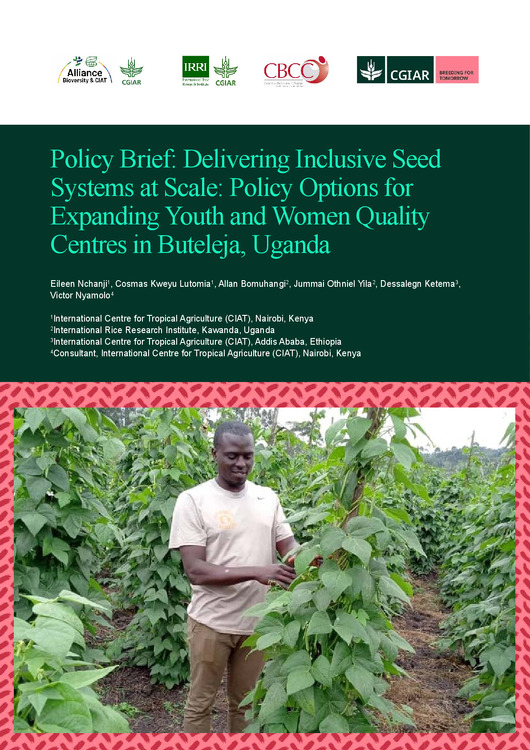
Common bean is a cornerstone of food security, nutrition, and household incomes in Uganda, particularly for women
smallholder farmers. However, access to quality bean seed remains limited. At baseline, only 42% of bean farmers
had ever planted an improved bean variety. Majority of the farmers relied on informal seed sources such as local
grain markets and neighbors. Women, who account for nearly 70% of bean producers, face disproportionate barriers
to certified and quality-declared seed, while youth struggle to enter the bean value chain beyond subsistence
production. Poor seed quality, repeated recycling, and weak local seed markets continue to suppress yields,
incomes, and resilience.
Evidence from the Youth and Women Quality Centre (YWQC) pilot demonstrates that decentralized, cooperative
based seed delivery models can rapidly transform bean seed systems. Between 2021 and 2024, adoption of
improved bean varieties increased from 42% to over 90% among participating farmers. Women’s adoption rose
from 42% to 91%, effectively closing the gender gap in access to improved bean seed. Farmers shifted away from
high-risk informal markets toward local quality seed multipliers, while the average duration of bean seed recycling
declined significantly. Youth emerged as active participants in bean production and seed enterprises, viewing beans
as a low-cost, high-potential entry point into agribusiness.
The results show that low adoption of improved bean seed is not driven by farmer resistance or lack of awareness,
but by structural failures in seed delivery systems, particularly for crops perceived as commercially unattractive
by the private sector. Locally anchored models that integrate seed multiplication, skills development, and market
linkages can overcome these constraints at scale. Therefore, institutionalizing decentralized bean seed delivery
through Youth and Women Quality Centres offers a viable pathway to strengthen food security, enhance productivity,
and promote inclusive economic participation. Embedding such models within national seed policy implementation
and district agricultural plans would enable wider access to quality bean seed, empower women and youth as seed
system actors, and build resilient local seed markets capable of sustaining gains beyond project cycles.