
Pastoral climate advisory for Ethiopia during October to December 2026
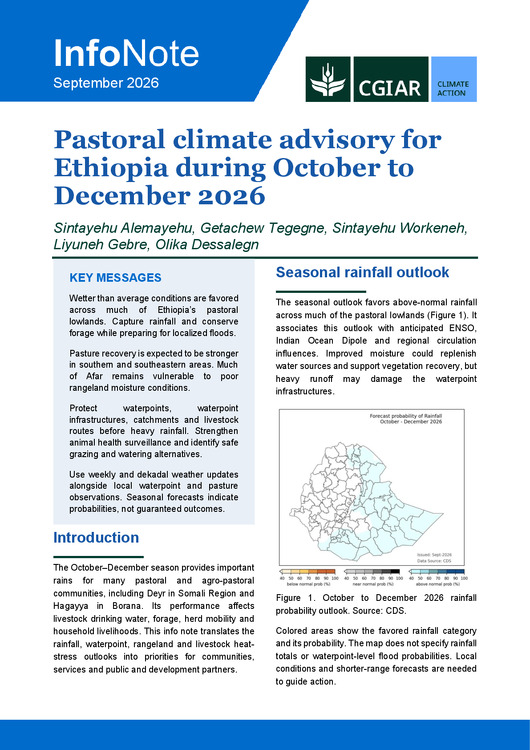
This info note presents an integrated climate advisory for pastoral and agro-pastoral areas of Ethiopia for the October–December (OND) 2026 season, translating seasonal rainfall forecasts and current water and pasture conditions into practical actions for pastoral communities, service providers, local authorities, and development partners. The seasonal outlook favors wetter-than-average conditions across much of Ethiopia’s pastoral lowlands, creating opportunities to replenish livestock water sources, regenerate pasture, increase fodder availability, and support livestock recovery. However, the outlook also indicates risks from localized heavy rainfall and flooding that could damage water infrastructure, restrict livestock movement, disrupt access to grazing and watering areas, and increase pressure on alternative resource areas. The advisory therefore emphasizes that seasonal forecasts represent probabilities rather than guaranteed outcomes and should be continuously updated using shorter-range forecasts and local observations. Conditions at the beginning of the October remain challenging. September 2026 monitoring shows substantial variation in water availability, with several monitored waterpoints under watch, alert, near-dry, or seasonally dry conditions. The anticipated OND rainfall provides an opportunity for recovery, but actual replenishment will depend on rainfall distribution, runoff, sedimentation, catchment conditions, and the physical condition of individual waterpoints. The note consequently recommends pre OND actions such as desilting ponds, clearing inlets and outlets, repairing embankments, protecting catchments, and identifying alternative water sources and livestock routes. Pasture conditions are similarly critical, with the September assessment indicating very low biomass of less than 0.5 tonnes/ha across more than 95% of the assessed Afar, Borana, and Somali pastoral areas. Although wetter conditions could stimulate pasture regeneration and fodder production, recovery is expected to vary spatially and temporally, with Afar remaining particularly vulnerable following poor rainfall and depleted resources. The advisory adopts a month-specific anticipatory-action approach. In October, priority is given to maintaining livestock support, preparing water infrastructure, verifying pasture and water recovery, and establishing safe grazing, watering, and movement arrangements before major herd movements. November focuses on adapting livestock movements to evolving rainfall and flood conditions, protecting recovering rangelands, managing water access, strengthening animal-health surveillance, and preventing resource-related conflict. By December, the emphasis shifts toward converting seasonal gains into water and forage reserves for the subsequent dry period, including haymaking, protected fodder storage, equitable grazing and water allocation, rehabilitation of damaged infrastructure, and evaluation of early actions.