
Nutrient response of early vegetative growth in cacao: Preliminary results from the cocoa soils core trials
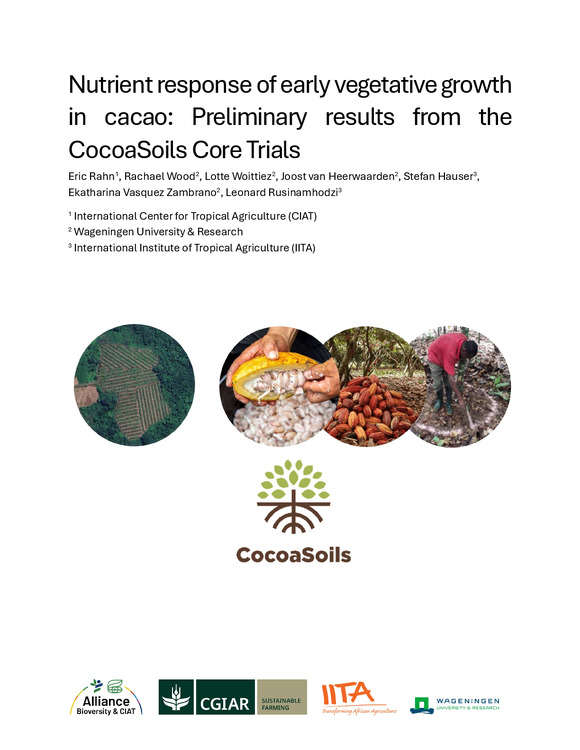
Cocoa is an important commodity crop for smallholder farmers in West and Central Africa. Cocoa cultivation in these countries has historically increased production through land expansion, often at the expense of forest, however, this is no longer feasible. Yield continues to be low, which is hindering improvements in farmer livelihoods and is not keeping pace with global demand. One of the important limiting yield factors is the high tree-by-tree heterogeneity in vigor and productivity. Early vegetative growth metrics, which refer to measurements done within the first 12 months after planting, may be predictive of subsequent reproductive development, including the timing of flowering, pod production, and overall productivity. Collecting such information at early stages could help identify trees with a low likelihood of achieving satisfactory yields later in their productive life. Early identification of poorly performing trees would allow farmers to remove and replace them in a timely manner, thereby reducing long-term yield losses and improving plantation efficiency. The CocoaSoils program established ten experimental research trials across Côte d’Ivoire, Ghana, Nigeria and Cameroon, Indonesia, and Ecuador to study nutrient responses. The trial design responds to the evaluation of four fertilizer levels of nitrogen, phosphorous, and potassium. Preliminary results indicate that potassium and nitrogen are significant for vegetative growth, despite current fertilizer recommendations not including nitrogen. There is an inflection point after which responses decrease, indicating economic fertilizer levels. Higher early vegetative growth leads to earlier flowering, and more pods and stem diameter is a good indicator for future productivity.