
No systems transformation without systems literacy: Insights from CGIAR
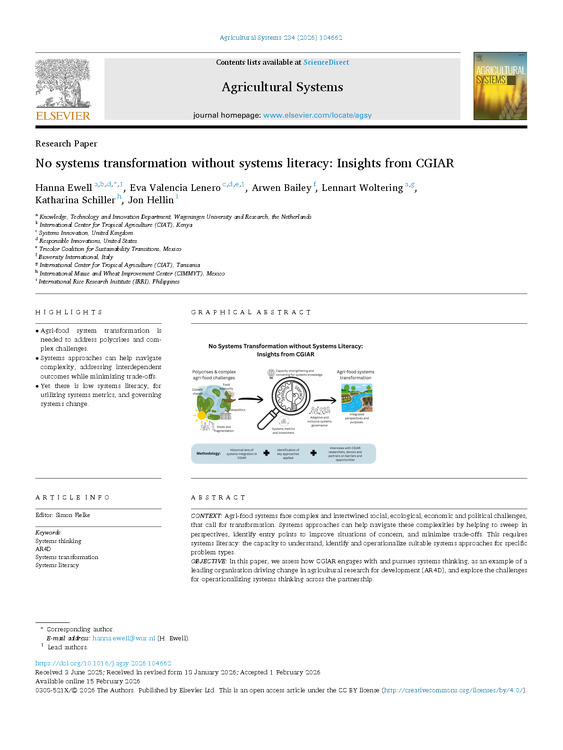
CONTEXT
Agri-food systems face complex and intertwined social, ecological, economic and political challenges, that call for transformation. Systems approaches can help navigate these complexities by helping to sweep in perspectives, identify entry points to improve situations of concern, and minimize trade-offs. This requires systems literacy: the capacity to understand, identify and operationalize suitable systems approaches for specific problem types.
OBJECTIVE
In this paper, we assess how CGIAR engages with and pursues systems thinking, as an example of a leading organisation driving change in agricultural research for development (AR4D), and explore the challenges for operationalizing systems thinking across the partnership.
METHODS
A qualitative approach was used combining a review of literature and semi-structured stakeholder interviews, ranging from current and past research staff, academics, and practitioners, to gather insights into the understanding and operationalization of systems thinking within the case study of CGIAR.
RESULTS AND CONCLUSIONS
Our findings show that despite a commitment to food system transformation, to which systems approaches are inherent, systems thinking is underutilized in CGIAR. The results of the interviews point to limited systems literacy, with diverse interpretations of ‘systems thinking’, scattered adoption of systems approaches, and little intentional selection of different systems approaches for different problematic situations. They underscore an opportunity to better benefit from systems approaches by more intentionally engaging with various Systems approaches and fostering ‘systems literacy’, encompassing systems knowledge, governance and investment.
SIGNIFICANCE
Systems thinking offers practical methodologies and tools to improve the complex and interconnected challenges towards agri-food system transformation, yet its effective application would benefit from greater ‘systems literacy’ in AR4D.