
Madagascar gender strategy: Building Equitable Climate Resilient African Bean and Insect Sectors (BRAINS) Project
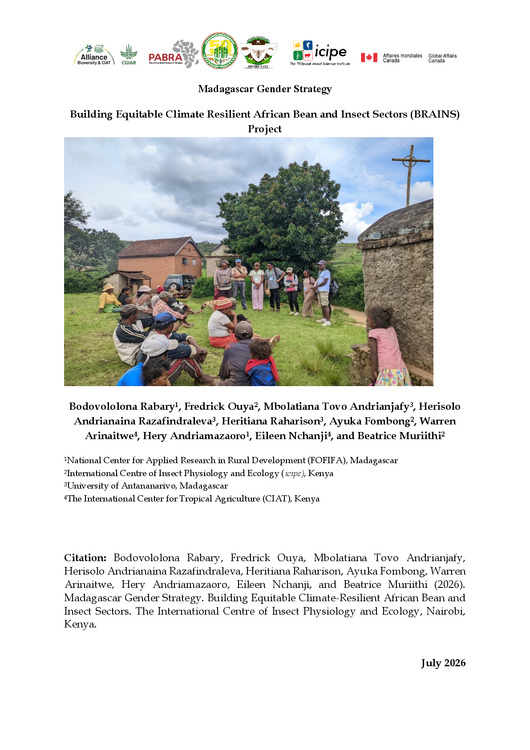
The Building Equitable Climate-Resilient African Bean and Insect Sectors (BRAINS) project is a multi-country programme implemented in 15 Sub-Saharan African nations, including Madagascar. The project aims to advance low-carbon, climate-resilient, and inclusive agricultural systems across the bean, fruit tree, and insect farming value chains by facilitating the adoption of climate-smart agriculture (CSA) technologies, strengthening climate resilience among at-risk farming communities, and promoting gender-responsive agribusiness development in line with emerging climate finance priorities.
Agriculture underpins Madagascar's economy and rural life, engaging the majority of the population and significantly enhancing food security, employment, and household incomes (World Bank, 2024). The sector is predominantly composed of smallholder farmers who rely heavily on rain-fed agriculture, which is increasingly jeopardised by climate variability and environmental degradation (IPCC, 2022). Common beans, fruit trees, and nascent insect-based industries are essential for household nutrition, income generation, and livelihood diversification in rural communities. Nonetheless, persistent structural impediments, such as low productivity, insufficient extension services, substandard rural infrastructure, weak market integration, and limited access to quality agricultural inputs, continue to undermine agricultural transformation and resilience in Madagascar (WFP, 2024; World Bank, 2024).
Climate change has exacerbated these challenges through unpredictable rainfall patterns, prolonged droughts, flooding, elevated temperatures, and heightened pest and disease occurrences, all of which adversely affect agricultural output and family food security (IPCC, 2022). The BRAINS quantitative gender analysis in Madagascar indicated that farming households are increasingly facing climate-related shocks, notably erratic rainfall, extended droughts, reduced yields, and pest infestations, which adversely affect bean and fruit tree production systems. Climatic shocks disproportionately affect women farmers owing to pre-existing disparities in access to productive resources, climate information services, technologies, land ownership, extension support, and market opportunities.
Gender inequalities persist profoundly within Madagascar's agricultural frameworks. Despite women's significant contributions to agricultural production, seed preservation, post-harvest management, household nutrition, and climate adaptation practices, they continue to face systemic obstacles that restrict their participation in lucrative agricultural value chains and decision-making processes (Achandi et al., 2018; FAO, 2023). The BRAINS gender analysis in Madagascar identified substantial gender disparities in land ownership, literacy rates, mobile phone ownership, access to productive resources, and market engagement. Male farmers often managed larger landholdings, generated greater marketable surpluses, and engaged more extensively in commercial markets, while women were predominantly involved in household-oriented production and informal seed systems. Women were found to be more vulnerable to drought, yield declines, pests, and water management issues, indicating reduced adaptive capacity and resilience to the effects of climate change.
These gendered disparities align with extensive evidence across Sub-Saharan Africa, where inequitable access to resources, decision-making authority, agricultural technologies, and climate adaptation services persistently hampers women’s productivity, resilience, and economic empowerment (Agarwal, 2018; FAO, 2023; Pinho-Gomes & Woodward, 2024). Young people face significant obstacles, including restricted access to productive resources, limited financial services, weak market connections, and declining interest in agriculture due to low profitability and climate-related hazards.
The Madagascar Gender Strategy sets out how the BRAINS project will address gender and climate-related concerns to ensure equitable participation, benefit-sharing, empowerment, and change across the value chains of bean, fruit tree, and insect farming. The plan provides a comprehensive framework for integrating gender equality and social inclusion across project design, implementation, monitoring, and sustainability processes. This initiative utilises the Reach, Benefit, Empower, and Transform (RBET) framework, the socio-technical innovation bundling approach, and the Youth and Women Quality Centre (YWQC) model to improve equitable access to resources, strengthen climate resilience, enhance livelihoods, and foster inclusive agricultural transformation for women, youth, and other vulnerable and marginalised populations in Madagascar.