
Leadership Training Tool: Empowering women leaders for climate resilience and community change
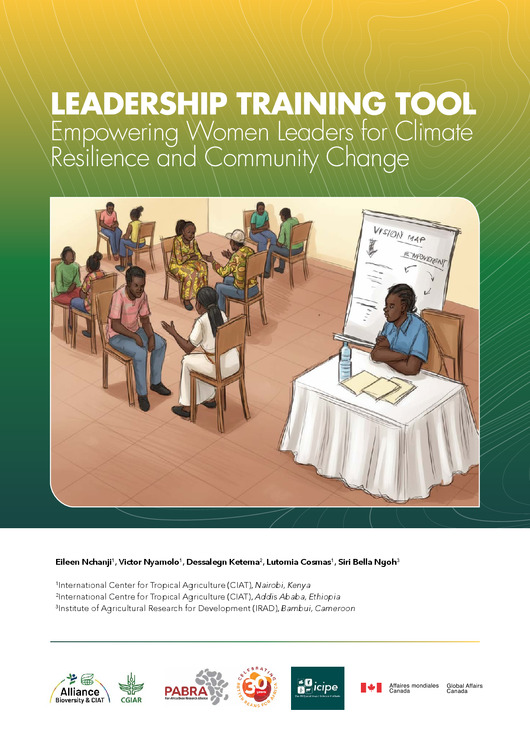
The Leadership Training Tooll: Empowering Women Leaders for Climate Resilience and Community Change
is a comprehensive, participatory training guide designed to strengthen women’s leadership capacity in rural
and semi-urban contexts. Developed by the Alliance of Bioversity International, CIAT, and partners, the manual
responds to persistent gender gaps in leadership, decision-making, and access to influence, particularly in
sectors linked to climate adaptation, agriculture, and local economic development.
The manual provides a structured two-day training program, complemented by follow-up and sustainability
mechanisms, to support women as confident leaders, advocates, and change agents within their communities.
Its core objective is to equip women with practical leadership skills while addressing the personal, social, and
structural barriers that often limit their participation and voice.
Grounded in adult learning principles, the manual emphasises experiential, learner-centred methods rather than
lecture-based instruction. Training activities include group discussions, role-plays, visual tools, self-reflection
exercises, peer coaching, and action planning. The design is inclusive of participants with mixed literacy levels
and is adaptable to diverse cultural contexts.
The training is organised into eight modules across two days. Day One focuses on foundational leadership
concepts and self-discovery, guiding participants to define leadership, explore values, identify personal leadership
styles, and address self-doubt and gender-based barriers. Day Two builds practical skills in communication,
public speaking, decision-making, conflict management, networking, and advocacy. The program culminates in
individual action plans and commitments to support peer leadership development.
A distinctive feature of the manual is its emphasis on collective leadership and sustainability. Participants are
supported to form accountability partnerships, mentoring relationships, and peer networks, with structured
three- and six-month follow-up sessions to reinforce learning, track progress, and scale impact. The “change
agent” model encourages women to mentor others and apply their skills beyond the training space.
Overall, the manual offers a scalable, context-responsive approach to women’s leadership development. By
combining personal transformation with practical skills and community engagement, it contributes to stronger
women’s leadership, enhanced climate resilience, and more inclusive local governance and development
processes.