
Leadership training report - Siha, Tanzania. Building Gender Equitable Resilience for Adaptation to Climate Across Bean Crop and Insect Corridors (BRAINS)
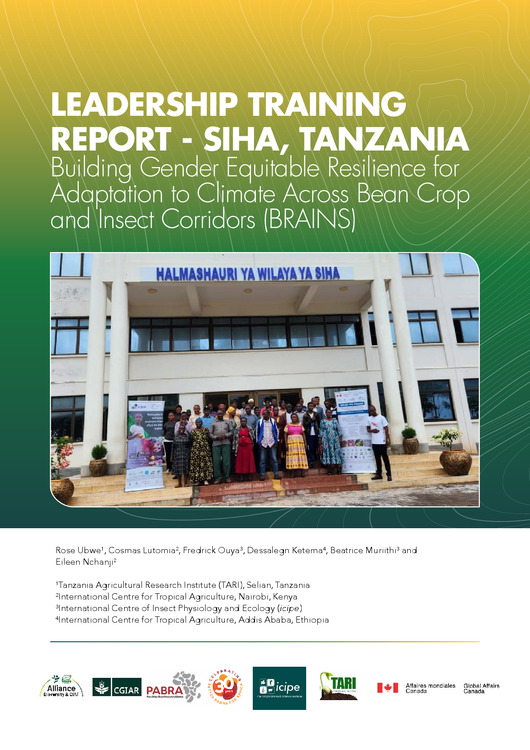
This report presents the outcomes of a two-day leadership training workshop held on March 25–26, 2026, at
the Siha District Council in Kilimanjaro Region, Tanzania. The intervention is a component of the BRAINS project
(2024–2028), funded by Global Affairs Canada and implemented by partners including the Tanzania Agricultural
Research Institute (TARI), the Alliance of Bioversity International and CIAT, and the International Centre of Insect
Physiology and Ecology (icipe).
The training is grounded in the BRAINS project’s rationale that technical agricultural interventions such as
climate-resilient seed varieties cannot succeed without a foundation of effective local leadership. In many rural
settings, concentrated power structures marginalise women and youth. The central objective was to empower
women and youth as active agents of change, build their leadership confidence, and equip diverse community
influencers (lead farmers, elders, group representatives) with public speaking, negotiation, and decision-making
skills required for inclusive governance of agricultural value chains.
The workshop employed participatory, adult-learning methodologies delivered in Kiswahili. These literacy
neutral approaches included role-playing, group dialogue, experiential learning scenarios, and visual tools such
as the “Tree of Life” creative mapping exercise. A total of 29 participants attended, comprising 17 males and 12
females (41.4% women). Intergenerational mentorship was a focus, with youth (ages 18–35) accounting for 37.9%
of the group.
The two-day curriculum shifted focus from self-awareness on Day 1 to application within formal structures on Day 2.
• Participants redefined leadership as a multifaceted responsibility based on service, influence, and integrity
rather than formal titles, moving beyond gendered stereotypes of roles.
• The training emphasised transformational, democratic, and situational styles, teaching flexibility over fixed
traits. Participants demonstrated a strong collective preference for democratic leadership (consensus
building and dialogue) when solving agricultural demonstrations, financial, or systemic inequality challenges.
• Focused listening and public speaking exercises emphasised that a leader’s primary role is to be a clear
“messenger,” validating community needs and ensuring a mutual exchange of ideas.
• The session dismantled the “solo commander” myth in favour of shared resilience. Participants identified
multi-layered psychological, socio-cultural, and structural barriers that prevent women and youth from
accessing leadership roles in cooperative boards and local governance.
• Leaders were trained in analysing “pros and cons” before acting, mapping stakeholders by influence and
interest, and developing specific pathways to increase women and youth inclusion in cooperatives.
Key Findings and Commitments Evaluation and observations revealed several critical shifts in thinking:
• A core finding was the critical recognition that leadership begins at the household level. Participants identified
that sharing land and farming responsibilities equitably with spouses is a prerequisite for wider community
economic health. Effective management of community groups and resources was explicitly viewed as
a direct path to the “fruits” of financial independence and self-sustainability. Participants understood that
solving systemic barriers requires altering organisational rules and cultural structures, not just coaching
marginalised individuals. Participants committed specific post-training actions within their households,
groups, or communities. These included: mentoring daughters for future leadership; sensitising communities
to support persons with disabilities; sharing farming duties jointly as a household; and actively integrating
women into the avocado supply chain and coffee cooperative aggregation (including husbands providing
land to wives for their independent coffee production).
The training was assessed as successful, shifting traditional, hierarchical views toward inclusive, democratic, and
growth-oriented leadership models. The report recommends targeting and addressing systemic community
barriers that block project initiatives. Implementing follow-up “mentorship” visits to ensure application of skills
and scaling this training model to other districts to maximise impact