
Leadership training report - Malawi: Building Equitable Climate-Resilient African Bean & Insect Sectors (Brains)
The Building Equitable Climate-Resilient African Bean & Insect Sectors (BRAINS) Project is a five-year initiative
funded by Global Affairs Canada and implemented in Malawi by the Department of Agricultural Research Services
(DARS) in partnership with the Pan-Africa Bean Research Alliance (PABRA), the Alliance of Bioversity International
and CIAT, and icipe. The project promotes climate-resilient and low-carbon agricultural development while
strengthening gender equality and social inclusion across bean, fruit-tree, beekeeping, and insect-for-food-and
feed value chains.
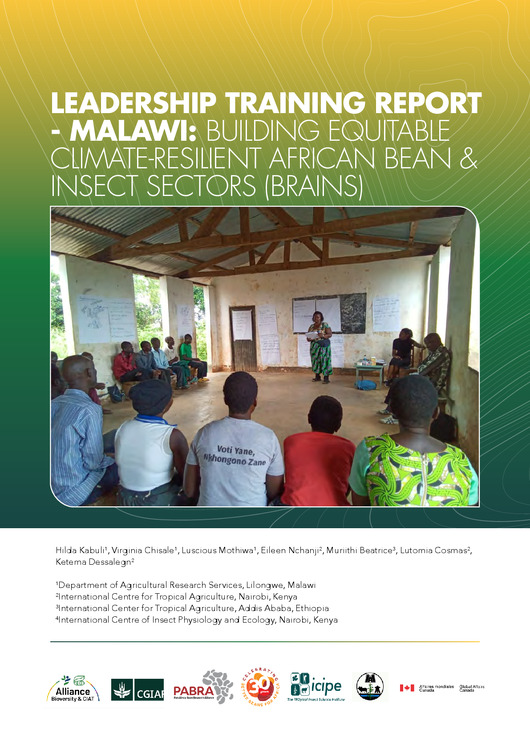
To strengthen equitable participation and leadership among community members, BRAINS conducted leadership
training workshops in Mwanza, Zomba, Rumphi, and Nkhatabay districts beginning in April 2026. The training
sought to empower women and youth with practical leadership, communication, decision-making, and problem
solving skills while addressing personal, social, and structural barriers that limit their participation in leadership
and decision-making processes. A total of 109 participants were trained, comprising 56 men, 53 women, and 35
(% female) youth. The workshops targeted leaders and emerging leaders from producer groups, cooperatives,
and community organisations.
The training adopted a participatory and learner-centred approach using adult learning methodologies, including
group discussions, self-reflection exercises, role-plays, visual tools, and plenary sessions. Sessions were delivered
in local languages to ensure inclusivity and engagement across varying literacy levels. Key topics covered included
leadership concepts and values, leadership styles, self-awareness and personal leadership development,
overcoming leadership barriers, communication and public speaking, decision-making, networking, advocacy,
and action planning.
A major component of the training was the use of innovative gender-transformative tools such as the Gender
Diamond Tool and the Tree of Life Tool. The Gender Diamond Tool facilitated reflection on leadership qualities
valued in men and women leaders and challenged gender stereotypes surrounding leadership. Discussions
emphasised that effective leadership qualities, including empathy, integrity, perseverance, and patience, are
not inherently linked to gender but can be learned and developed. These conversations created a platform for
participants to reflect on the challenges women face in leadership and identify strategies for increasing women’s
participation and influence in community governance structures.
The Tree of Life Tool encouraged participants to reflect on their personal leadership journeys, strengths,
achievements, aspirations, and leadership potential. Through this exercise, participants recognised their
existing leadership capacities and reflected on how family experiences, community interactions, and personal
achievements have shaped their leadership pathways. Facilitators particularly emphasised the importance of
recognising and celebrating the achievements of women and youth, whose contributions are often overlooked
or undervalued.
The training further addressed barriers to leadership at individual, social, and institutional levels. Participants
identified challenges such as low self-confidence, fear of public speaking, gender stereotypes, limited family
support, restricted access to resources, and exclusion from decision-making spaces. Strategies for overcoming
these barriers included confidence-building, mentorship, collective action, networking, advocacy, and greater
inclusion of women and youth in leadership structures. Communication and public speaking sessions provided
practical opportunities for participants to build confidence and receive constructive feedback.
Training evaluations indicated high levels of participant satisfaction. Most participants reported that the training
was highly beneficial and expressed commitment to applying the knowledge and skills acquired in their
communities. Participants also pledged to share lessons learned with other community members, thereby
extending the reach and impact of the training.
Overall, the leadership training contributed to the BRAINS project’s broader goal of fostering gender
transformative, climate-resilient, and inclusive agricultural systems. By strengthening leadership capacities
among women, youth, and community leaders, the training helped lay the foundation for increased participation
in decision-making, stronger community organisations, and more equitable and sustainable development
outcomes.