
Leadership training report – Ghana. Building Gender Equitable Resilience for Adaptation to Climate Across Bean Crop and Insect Corridors (BRAINS)
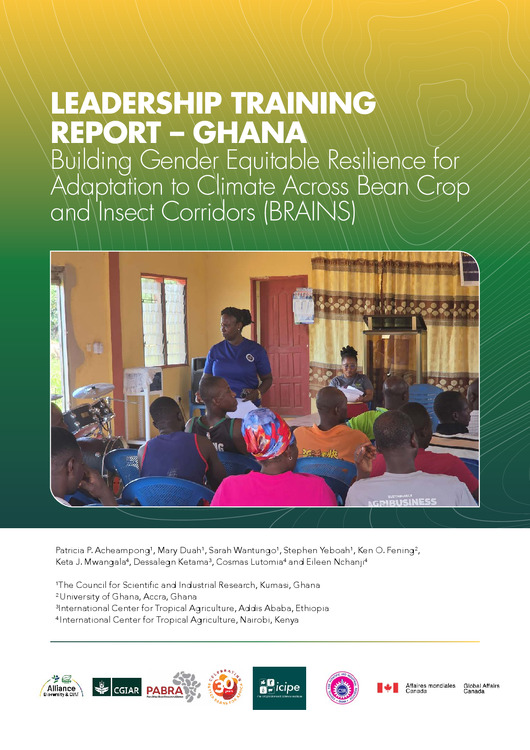
In the effort to build climate resilience and strengthen agricultural development, it is critical to recognize women not as passive beneficiaries, but as active economic agents and architects of their communities. The Leadership training tool developed under the BRIANS project is a comprehensive, participatory guide designed to strengthen women's leadership capacity in rural and semi-urban contexts. This manual directly addresses persistent gender gaps in decision-making and access to influence, particularly in sectors related to climate adaptation and local economic development.
The core objective of the manual is to equip women, youths and men with practical leadership skills while simultaneously addressing the personal, social, and structural barriers that limit their voice and participation. Moving away from traditional lecture-based instruction, the tool utilises experiential, learner-centred methods grounded in adult learning principles. Through group discussions, role-plays, visual tools, and self-reflection exercises across a two-day structure, the training empowers women to overcome self-doubt and navigate systemic gender-based barriers.
Furthermore, the training emphasises collective leadership and sustainability through a "change agent" model, in which participants are supported in forming accountability partnerships and peer networks. With structured follow-up mechanisms, the program ensures that women are equipped to mentor others and apply their skills beyond the training space, ultimately fostering more inclusive local governance and driving sustainable community change
The objective is to empower women and youth as active agents of change, to recognise their leadership potential, and to build confidence to influence community and climate decisions.