
Leadership Training Report-Ethiopia. Building Gender Equitable Resilience for Adaptation to Climate Across Bean Crop and Insect Corridors (BRAINS)
Strong and inclusive leadership is fundamental to achieve sustainable agricultural transformation. While
investments in improved seed systems, climate-smart agriculture and market development remain important,
these interventions cannot deliver lasting impacts without local leaders who can mobilize communities, negotiate
resources, resolve conflicts and promote inclusive decision-making. Recognizing this, the BRAINS project
integrates leadership development as a strategic pathway for strengthening gender-equitable resilience across
bean and insect value chains.
To contribute to this objective, a two-day Leadership and Strategic Advocacy capacity-building programme was
organized at Melkasa Agricultural Research Center (MARC), Ethiopian Institute of Agricultural Research (EIAR)
from 2–3 July 2026. This report documents the Leadership Training conducted on 2 July 2026, while the Strategic
Advocacy Training is presented in a separate companion report.
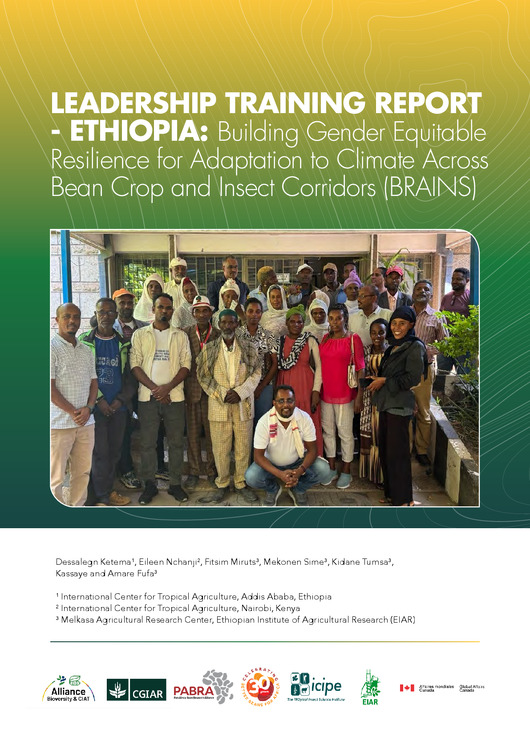
The Leadership Training brought together 29 participants, comprising 15 women (51.7%) and 14 men (48.3%),
representing farmers, agricultural experts, entrepreneurs and local institutions. In addition, approximately nine
researchers and administrative staff from Melkasa Agricultural Research Center participated as co-facilitators and
technical resource persons, strengthening institutional ownership of the programme.
Unlike conventional leadership workshops that focus primarily on theoretical concepts, this training adopted an
experiential learning approach that enabled participants to critically reflect on their own leadership journeys while
simultaneously developing practical leadership competencies. Sessions combined participatory presentations,
facilitated dialogue, group work, role-playing, visual learning tools, and reflective exercises that encouraged
participants to analyse leadership from personal, organizational and community perspectives.
Participants explored leadership beyond formal positions of authority and collectively redefined it as the ability to
influence positive change through vision, integrity, accountability, service and collaboration. Particular emphasis
was placed on strengthening women’s and youth leadership, addressing structural barriers that limit participation,
improving communication skills and understanding how different leadership styles can be applied to different
agricultural and community situations.
One of the most significant outcomes of the training was the shift in participants’ perceptions regarding leadership.
Rather than viewing leadership as something reserved for educated individuals or those occupying formal
positions, participants increasingly recognized leadership as a responsibility that begins within households,
farmer groups and communities. Through the Tree of Life exercise, many participants acknowledged that their
life experiences, community knowledge and everyday problem-solving abilities already represented important
leadership assets.
The training further strengthened participants’ understanding of democratic, transformational, servant, and
situational leadership approaches. Practical role-play sessions demonstrated that effective leadership requires
flexibility rather than reliance on a single leadership style. Participants learned to adapt their leadership
approaches according to community needs, emergencies, organizational maturity, and stakeholder expectations.
Group discussions also highlighted persistent barriers preventing women and youth from assuming leadership
positions within cooperatives and community institutions. These barriers included restrictive gender norms,
limited confidence, unequal access to leadership opportunities, limited mentorship, and institutional practices
that unintentionally reinforce exclusion. Participants proposed practical solutions including mentorship
programmes, leadership quotas, capacity development opportunities, and greater community awareness on
inclusive leadership.
The training concluded with individual leadership commitments in which every participant identified concrete
actions they would implement within their respective communities. Participants further committed themselves
to mentoring at least 25 additional community members, thereby creating a multiplier effect that will extend the
4 BRAINS GENDER STRATEGY
benefits of the training beyond the initial participants.
Overall, Leadership Training successfully strengthened participants’ confidence, communication skills,
collaborative leadership practices and understanding of inclusive governance. The report concludes that
sustained mentoring, institutional support and continued investment in grassroots leadership development will
be essential for translating these newly acquired skills into measurable improvements in agricultural innovation,
community resilience and gender-equitable rural development.