
Leadership training report - Cameroon. Building Gender Equitable Resilience for Adaptation to Climate Across Bean Crop and Insect Corridors (BRAINS)
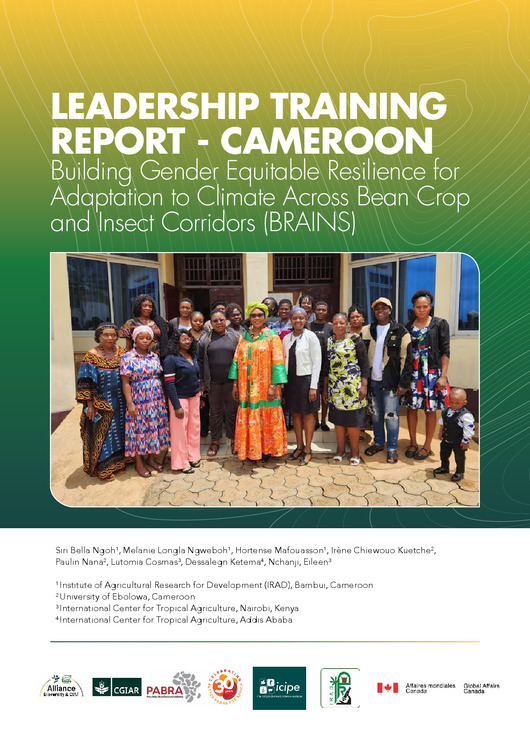
A two-day leadership workshop for women was held in Bamenda, Cameroon, on March 26th–27th, 2026, aimed
at bolstering women’s leadership skills. This initiative sought to address persistent gender imbalances that leave
women underrepresented in leadership, decision-making, and influence, particularly in critical areas such as
climate change adaptation, agricultural practices, and overall community development. The sessions focused
heavily on navigating and overcoming a broad spectrum of personal, social, and structural barriers that have
historically inhibited women’s full and active participation.
The workshop utilised the specialised curriculum titled “Leadership Training Tool: Empowering Women
Leaders for Climate Resilience and Community Change,” developed by the Alliance of Bioversity International
and CIAT, along with partners. A highly interactive and participatory approach was employed throughout the two
day training. The initial day focused on internal self-exploration, introduced fundamental leadership concepts,
and analysed specific gender-related challenges. The second day was dedicated to hands-on skill development.
A total of 23 women were in attendance, bringing together staff members from the Institute of Agricultural
Research for Development (IRAD), a consultant representing the International Centre of Insect Physiology and
Ecology (icipe), and members of the FASFECAM AGRIC Women organisation. Demographically, the group
was predominantly composed of women over 35 (65%), with 35% identifying as youth; notably, no participants
reported living with any disabilities.
Workshop activities were structured around self-reflection and practical application. Key components included:
• Defining leadership and exploring core leader values (vision, integrity, respect, inclusiveness, courage,
empathy, and accountability) through visualisation exercises like the “Leadership Tree” (roots = values, trunk
= skills, branches = actions, fruits = results).
• Utilising the “Tree of Life” analogy for personal reflection and peer sharing, followed by self-assessments of
leadership skills.
• Understanding democratic, autocratic, transformational, servant, and situational leadership styles, and
practising their application through scenario analysis.
• Identifying and proposing solutions to personal (e.g., financial, fear), socio-cultural (e.g., family heads
restrictions, stigmatisation), and structural (e.g., policy, wages, promotion bias) barriers faced by women
leaders.
• Interactive sessions on communication and public speaking (including “elevator speeches”), decision
making, problem-solving, building networks, and developing advocacy strategies.
• Turning decisions into concrete implementation steps, with each participant defining a goal and a specific
six-month leadership action, such as sharing learned knowledge or leading community training.
A post-training evaluation completed by 17 participants revealed the workshop’s strong impact. All respondents
agreed that the training content was relevant to their daily challenges and that facilitators made topics easy to
understand, equipping them with immediately usable practical skills. Key findings included:
• Leadership Identity: Increased significantly, with 100% of participants seeing themselves as leaders after
the training, compared to 88.2% before.
• Increased Confidence: Reported in areas like conflict management and resource mobilisation (88.2% each),
though confidence in advocacy was relatively lower (76.5%).
• Willingness to Mentor: 100% of respondents expressed willingness to mentor another woman or youth
member.
• Commitment to Action: 100% of participants stated a specific six-month leadership action.
Ultimately, the workshop’s ambition was to nurture a cadre of self-assured and skilful women leaders. By equipping
them with new leadership and advocacy tools, the organisers sought to empower them to spearhead community
LEADERSHIP TRAINING REPORT – CAMEROON
5
transformation, enhance climate resilience initiatives, and advance inclusive development. A follow-up meeting is
planned in three months to evaluate the training’s long-term impact on the group’s performance.