
Land suitability analysis and mapping for identifying areas of sunflower (Helianthus annuus L.) production expansion potential in Ethiopia
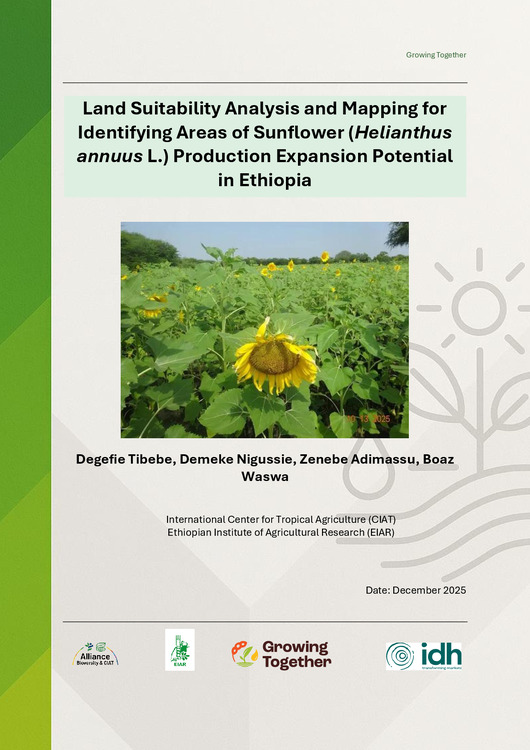
This study mapped Ethiopia’s rain-fed sunflower (Helianthus annuus L.) expansion potential using a GIS-based land suitability framework grounded in FAO suitability classes (S1, S2, S3, N). It integrated climate (rainfall, temperature, length of growing period), soil (pH, organic matter, texture, depth, drainage), and topographic factors (altitude, slope), complemented by land use masking to exclude non-agricultural areas such as protected zones, large water bodies, and built-up areas. A raster-based multicriteria evaluation (MCE) approach was applied, and the relative importance of the criteria was determined using the Analytic Hierarchy Process (AHP), which showed strong internal consistency (CR = 1.70%). At the national scale, the analysis indicates that sunflower expansion potential is substantial but geographically concentrated. Approximately 6.25 million ha (5.5%) of Ethiopia is highly suitable (S1) and 19.13 million ha (about 16.9%) is moderately suitable (S2), while 14.22 million ha (12.5%) is marginally suitable (S3). In contrast, about 73.94 million ha (65.1%) is not suitable (N) for rain-fed sunflower production under current conditions. The combined S1+S2 area—about 25.6 million ha (22.35% of national area)—defines the principal expansion belt that can realistically support scaling if matched with appropriate varieties and management. Suitability is unevenly distributed across regions, with Oromia, Amhara, Benishangul Gumuz, and the southern regions collectively holding the majority of the highly and moderately suitable land. Oromia contains the largest contiguous suitable area nationally and includes major zonal hotspots (e.g., West Hararge, Arsi, East Shewa, East Bale), while Amhara follows with extensive moderately suitable land suggesting wide scope for production if manageable constraints are addressed. Benishangul-Gumuz, South Ethiopia, and Southwest Ethiopia emerge as additional priority regions with strong potential for both expansion and commercialization, whereas Central Ethiopia and Sidama—though smaller—show high proportions of suitable land, indicating strong potential under intensified production systems. Somali and Afar are predominantly not suitable for rain-fed sunflower, implying that any meaningful sunflower development there would require irrigation-based niche systems rather than broad expansion.