
Integrative metabolomics and machine learning reveal anti-methanogenic compounds in low-methane-emission forages
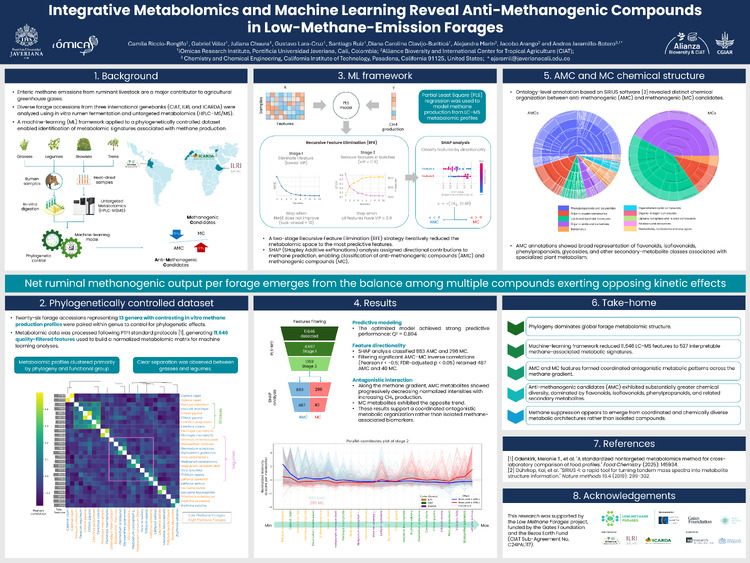
Enteric methane emissions from ruminant livestock are a major contributor to agricultural greenhouse gases, motivating the search for forage-based mitigation strategies. Although plant metabolites have been implicated in modulating rumen methanogenesis, the metabolic architecture underlying methane production remains poorly understood, particularly across phylogenetically diverse forage species. Here, we combined untargeted metabolomics, phylogenetically controlled comparisons, and predictive modeling to identify metabolic signatures associated with methane production in forage accessions from three international genebanks (CIAT, ILRI, and ICARDA). Our objective was to determine whether methane suppression is driven by individual biomarkers or by coordinated metabolic patterns spanning multiple chemical classes. Twenty-six forage accessions representing 13 genera with contrasting in vitro methane production profiles were selected from CIAT, ILRI, and ICARDA genebanks. Within each genus, low- and high-methane accessions were paired to control for phylogenetic effects. Untargeted LC–MS metabolomics generated 11,646 quality-filtered features following standardized processing and normalization procedures. Methane-associated features were identified using Partial Least Squares (PLS) regression combined with a two-stage Recursive Feature Elimination (RFE) strategy. SHAP (SHapley Additive exPlanations) values were used to quantify feature directionality and classify features as anti-methanogenic candidates (AMC) or methanogenic candidates (MC). Significant antagonistic interactions between AMC and MC features were evaluated using Pearson correlation and false-discovery-rate correction. Structural annotation was performed using SIRIUS. Global metabolomic organization was primarily driven by phylogeny and functional group, with clear separation between grasses and legumes. Predictive modeling reduced the metabolomic space from 11,646 detected features to 1,159 methane-associated features while achieving strong predictive performance (Q² = 0.804). SHAP analysis classified 863 features as anti-methanogenic candidates (AMC) and 296 as methanogenic candidates (MC). Along the methane gradient, AMC and MC exhibited opposing abundance patterns, with AMC progressively decreasing and MC increasing as methane production rose. Filtering significant inverse correlations (Pearson r < −0.5; FDR-adjusted p < 0.05) retained 487 AMC and 40 MC, revealing a structured antagonistic metabolic organization. Annotation analyses indicated that AMC were represented by a broad diversity of secondary-metabolite classes, including flavonoids, isoflavonoids, phenylpropanoids, glycosides, and related specialized metabolites. Within-genus comparisons further showed that methane-associated metabolic differences were largely lineage-specific, with no universal methane biomarker shared across all genera. These results suggest that methane production is not governed by isolated compounds but emerges from the balance among multiple metabolites exerting opposing effects on ruminal methanogenesis.