
IDENTIFICATION OF CIAT ADVANCED RICE LINES ABLE TO DISCRIMINATE PATHOGENIC DIVERSITY IN Magnaporthe oryzae
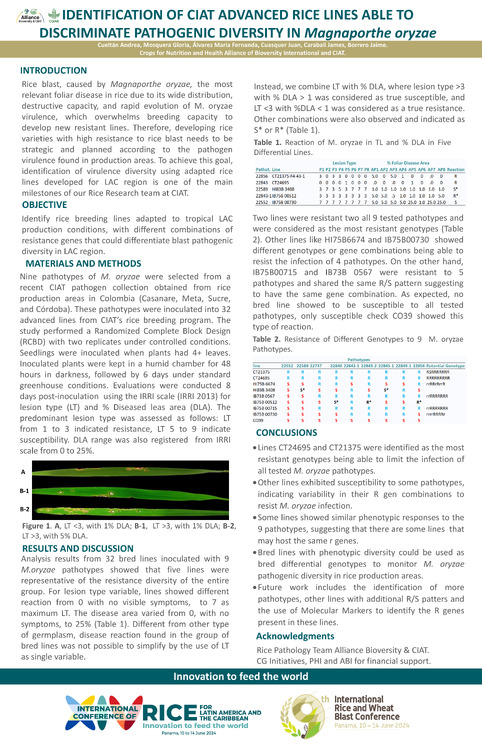
Rice blast disease is the most important biotic constraint for rice production in Latin America and The Caribbean (LAC) due to the high pathogenic diversity of Magnaporthe oryzae. The most common system to monitor pathogenic diversity is the use of differential sets with known resistance genes in the same genetic background. This system has not been broadly adopted in LAC due to the poor performance of differentials under LAC environmental conditions. For this reason, our goal was to identify rice lines with good agronomic traits and adapted to tropical LAC conditions, with different combinations of resistance genes that could differentiate blast pathogenic diversity present in LAC. To achieve this goal advanced lines from CIAT rice breeding program were selected to perform fungal pathotyping under greenhouse conditions. In a first study 45 isolates of M. oryzae collected in different rice production zones in Colombia were analyzed under greenhouse artificial inoculations on 5-leaf stage plants. Lesion type and foliar disease area data identified 9 distinct pathotypes, then these pathotypes were used in a subsequent study to identify promising Blast differential bred lines. Data analysis of 33 lines inoculated with pathotypes showed that two lines were resistant to the nine pathotypes, other tested showed susceptibility certain number of pathotypes, one line was susceptible to 8 of nine pathotypes, and none of the bred lines was susceptible to all tested pathotypes. This study provides agronomically relevant sentinel rice lines able to differentiate and monitor in real time blast pathogenic diversity present in rice production areas in LAC, with potential for direct use of their resistance into breeding pipelines to improve varieties and to promote a systematic disease monitoring system and a site-specific blast resistance strategy.