
HaFAS innovation use in Ethiopia: Research validation, on-farm piloting and advisory delivery
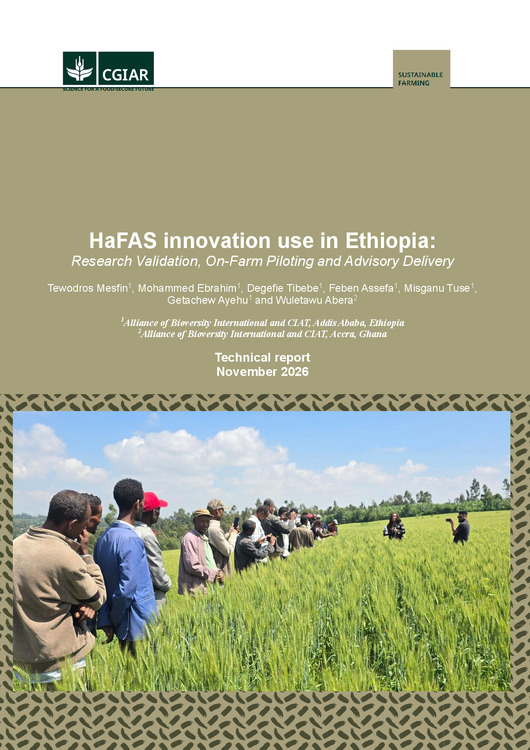
Harmonized Digital Fertilizer and Agronomic Solutions (HaFAS) has advanced from research validation to operational implementation within Ethiopia’s agricultural research, public extension, and digital advisory systems, integrating site-specific fertilizer recommendations with extension services, conversational advisory platforms, and input financing. This report synthesizes research findings, implementation records, and partner updates from 2024 to October 2026 to assess innovation uptake, emerging agronomic performance, and opportunities for sustainable scaling. Research validation and on-farm piloting covered wheat, maize, tef, and sorghum, generating 1,535 piloting-site records. During the 2024–2025 validation period, simple two-year average grain-yield advantages over conventional extension nitrogen–phosphorus recommendations were 31% for wheat, 7% for maize, 31.5% for tef, and 35% for sorghum. Although these unweighted descriptive averages suggest promising agronomic responses, variations in trial selection, agroecological conditions, and crop management limit their interpretation as pooled treatment effects or nationally representative estimates, while comparative yield results for 2026 remain unavailable. During 2025–2026, HaFAS implementation channels collectively documented 273,107 activity records encompassing advisory queries, advisory delivery, reported adoption, on-farm piloting, and input-financing services. Digital Green recorded 143,398 FarmerChat advisory queries and reported 73,014 farmers implementing HaFAS recommendations, while LERSHA reached 36,000 advisory recipients and supported 9,804 input-finance users. In addition, public extension services and research centers documented 9,356 advisory delivery and reported implementation records in 2026, of which 1,052 (11.2%) were associated with women. Capacity-development initiatives further recorded 455 training and orientation participations. However, because these indicators represent different activities and may overlap across delivery channels, the aggregated records should not be interpreted as the number of unique beneficiaries or independently verified adopters. Sustaining and expanding HaFAS implementation requires strong Ministry of Agriculture leadership, continued scientific validation, reliable digital infrastructure, effective extension support, and timely access to agricultural inputs and financing. Thematic Farmer–Research–Extension platforms and the Client Feedback Mechanism provide complementary mechanisms for stakeholder coordination and addressing implementation challenges, although the integrated digital feedback workflow still requires field validation. Future priorities should emphasize women’s participation, strengthen the traceability of advisory services to identifiable farm fields, and establish robust monitoring systems for verified fertilizer application, treated area, crop yields, and production costs. Independent evaluations across crops, agroecological settings, and production seasons will be essential to establish the agronomic effectiveness, economic profitability, nutrient-use efficiency, and long-term scalability of HaFAS in Ethiopia.