
Guideline for integrating orphan crops into modern agricultural systems while preserving traditional knowledge
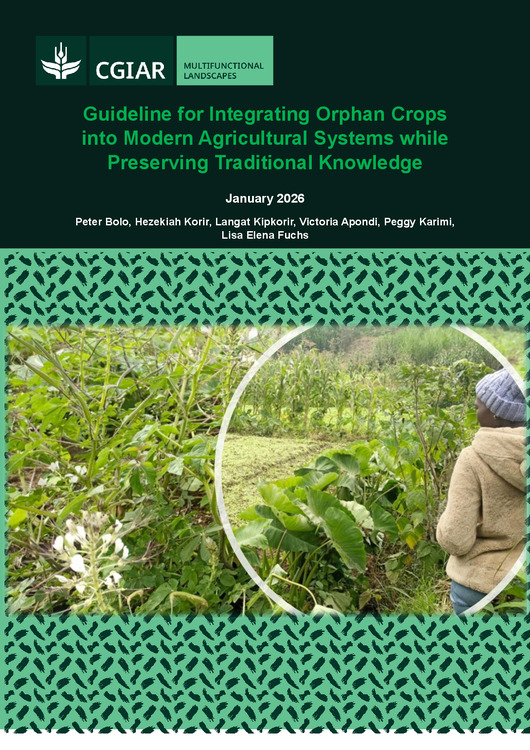
This document provides practical guidance for introduction or re-introduction of diverse orphan crops into existing/modern agricultural systems while preserving indigenous knowledge under different agroecological contexts. It could be applied when working with farmers, extension agents, development programs, or policy processes that aim to strengthen sustainable food systems through orphan crop integration, climate resilience, nutrition, and agroecological transitions. Although this document focuses on the orphan crops, much of the details can also be applied in integration and scaling of other crops. The steps discussed herein can be flexibly adapted to the local contexts as necessary. This guideline is not intended to be prescriptive; rather, it should be applied flexibly as a decision-support tool to improve contextual relevance and enhance the scaling potential of orphan crops. The document is structured into four sections. The first section provides purpose and scope of the document, followed by general introduction of the orphan crops. The third section provides the key considerations and practical illustrations for introduction or re-introduction of orphan crops in different contexts. Although there is growing discourse of orphan crops, limited knowledge about their production and preparation hinders their adoption, despite their potential to improve nutrition and food security. Therefore, the fourth section provides examples of select orphan crops and their agronomic production guidelines.