
A Guideline for Establishing and Operationalizing a Multi-Stakeholder Platform for Landscape Restoration and Payment for Ecosystem Services: The Case of Omo-Gibe Living Landscape, Ethiopia
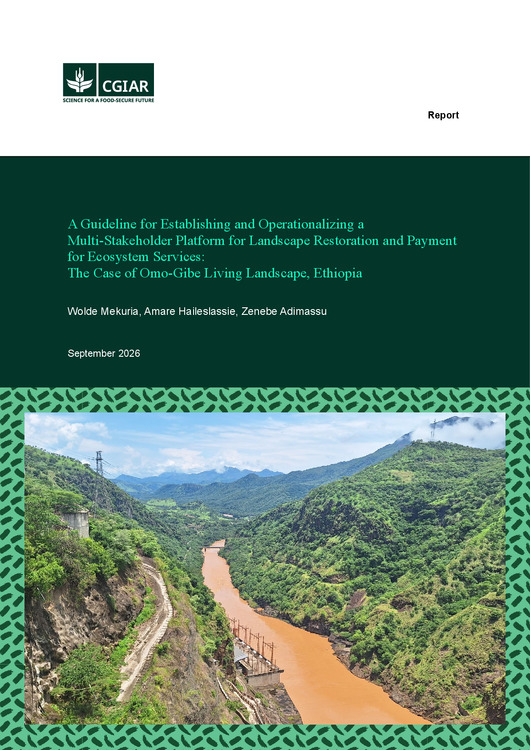
Prepared by the International Water Management Institute (IWMI) under the CGIAR Multifunctional Landscapes Science Program, this guideline provides a practical technical reference for establishing and operating a Multi-Stakeholder Platform (MSP) to advance landscape restoration and Payment for Ecosystem Services (PES) in Ethiopia's Omo-Gibe River Basin, with an initial focus on the Gibe III hydroelectric dam catchment — the MFL flagship living landscape — and a phased pathway for scaling to the wider basin. Intended users span federal, basin, regional and local authorities, private-sector operators, community and watershed institutions, development partners, NGOs and research organizations; it aims to inform, not replace, statutory processes.
Informed by national and sub-basin consultations that confirmed the need for coordinated upstream–downstream action integrating PES with restoration, it anchors the MSP in Ethiopia's enabling policy and legal framework covering environmental, watershed, basin, riparian-buffer, restoration and PES provisions. The guideline sets out a four-phase pathway: (1) diagnostic assessment and stakeholder mapping; (2) platform formalization and governance; (3) PES and restoration implementation; and (4) institutionalization within existing governance systems. Guided by inclusiveness, transparency, accountability, legal anchoring, gender equality and social inclusion, and a MEAL framework for adaptive learning, it offers a practical tool for translating policy into equitable, sustainable action.