
Governance through fair pricing: Co-constructing equity as a first step towards a dynamic, inclusive and certified institutional market for school canteens in Niakhar, Senegal
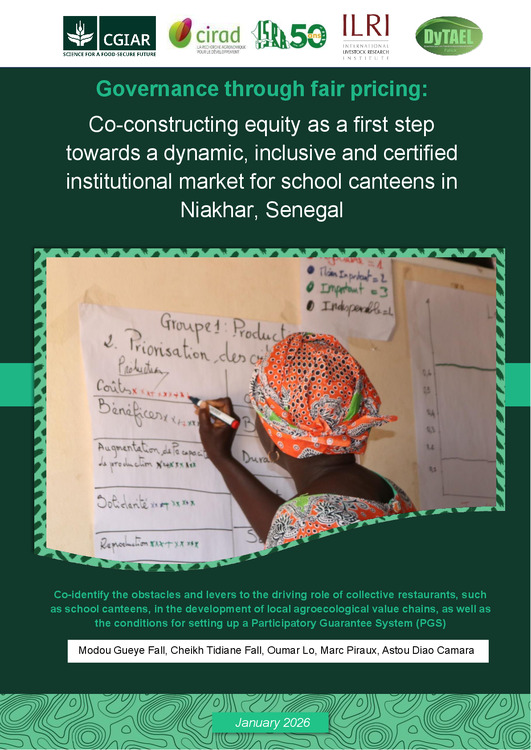
This study assesses the potential of the structured school canteen market as a lever for a viable
and equitable agroecological transition in the Niakhar municipality of Fatick Region, Senegal.
While institutional demand is driving the adoption of sustainable practices, price governance,
frozen since 2019, is jeopardizing the profitability of the dairy sector. To overcome this impasse,
a five-step participatory methodology was implemented. It combines a quantitative profitability
analysis (Benefit/Cost Ratio) with a qualitative co-construction approach with stakeholders. The
diagnostic confirmed the market's positive impact on producer resilience, but also the
unsustainability of historical prices (BCR < 1). A multi-stakeholder workshop enabled the
collective definition of criteria for a "fair price," followed by the evaluation of different
scenarios. The results identify a fair price mechanism of 650 FCFA/L for the producer and 1200
FCFA/L for the processor. This price pair is the only one to reconcile strong social legitimacy
(high perception of fairness), proven economic viability (BCR > 1), and support for
environmental sustainability. The study concludes that the sustainability of agroecological
transitions relies on adaptive governance mechanisms, where prices are not imposed but coconstructed, paving the way for participatory certifications (PGS) and more resilient and
equitable markets.