
Gender scan and scoping study report for Gamo Development Association (GaDA), Ethiopia
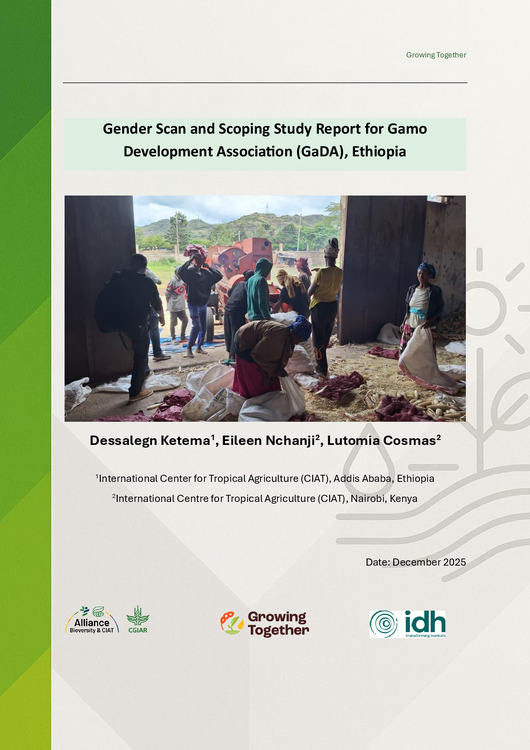
The Gender Scan and Scoping Study for Gamo Development Association (GaDA) was conducted under the Growing Together Project (2024–2028) funded by NORAD and implemented with IDH, with the aim of understanding how women and youth participate in, benefit from, and influence decision-making within GaDA’s maize seed value chain operations. The assessment goes beyond headcounts to examine structural issues in employment, leadership, workplace practices, supplier inclusion, and access to services and finance so that GaDA’s planned growth strengthens equity and empowerment rather than unintentionally reproducing inequalities. GaDA is a legally registered enterprise operating in the Gamo Zone (South Ethiopia Region) with strong institutional credibility and partnerships across government, research, and private sector actors. Its core business is maize seed multiplication, processing, packing, and distribution, while also engaging in other crops and horticulture. Strategically, GaDA aims to rapidly expand production and market share and plans to support 8,000 smallholder farmers with an explicit target of 40% women, offering a strong opportunity for gender-responsive and gender-transformative programming within seed sector development. Findings show a mixed inclusion picture. Women make up 35% of GaDA’s workforce and youth about 60%, indicating meaningful participation in rural employment. However, women and youth are concentrated mainly in casual and lower-level technical roles (planting, weeding, harvesting, packaging), with limited job security and progression. Leadership remains highly male dominated, with only two women/youth combined in decision-making roles, reflecting a clear “vertical gap” in influence over enterprise priorities and workplace conditions. At the value chain level, supplier inclusion is a major challenge: 90% of suppliers are men, while women account for only 10%, despite evidence that women suppliers perform equally well once included (no reported differences in volumes supplied, quality, or contracts). Finance constraints further limit transformation, as women and youth face barriers related to collateral, land ownership, and credit history. While GaDA has an equal pay policy, it lacks key protections such as formal workplace safety and anti-harassment measures, and it has no gender strategy or gender focal point, leaving inclusion efforts largely ad hoc. Overall, the study concludes that GaDA is currently gender-neutral but has strong readiness and demand for support to develop policies, capacity building, and targeted mechanisms to move women and youth into leadership roles, stable jobs, and equitable supplier participation positioning GaDA to become a model inclusive seed enterprise in Ethiopia.