
Gender, labor, and sustainable technologies in Amazonian dairy systems: Evidence from Colombia
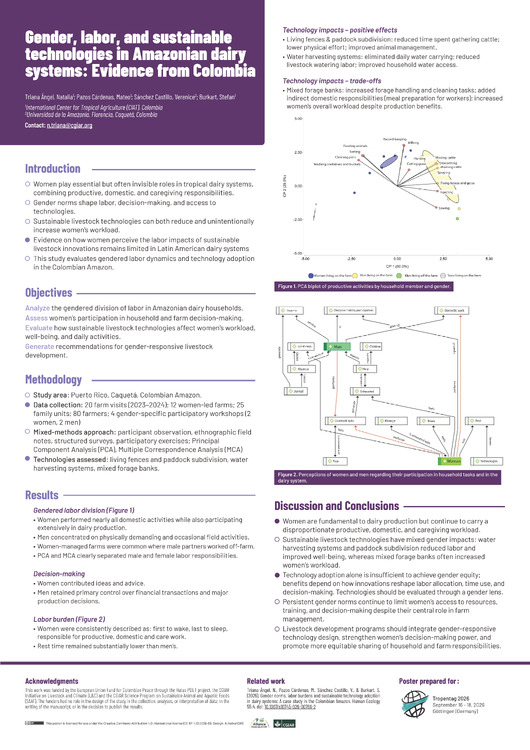
Gender norms strongly shape labor distribution, access to resources, and decision-making within livestock systems, often resulting in the invisibility and undervaluation of women’s contributions. In the Colombian Amazon, these dynamics intersect with the introduction of sustainable livestock technologies, raising important questions about their effects on women’s workload and well-being. This study examines gendered labor dynamics and analyzes how the adoption of new technologies influences women’s work burden and participation in dairy systems. The research was conducted in Puerto Rico, Caquetá (Colombia), within the framework of the Rutas PDET program. A mixed-methods approach was applied, combining ethnographic fieldwork, participant observation, and four gender-focused participatory workshops involving 80 farmers across 25 households. Qualitative data on household labor division, perceptions, and technology use were complemented with quantitative analyses, including Principal Component Analysis (PCA) and Multiple Correspondence Analysis (MCA), to explore associations between gender roles and farm activities. Results reveal a pronounced gendered division of labor, with women performing up to 80% of daily tasks, including both domestic and livestock-related activities such as milking, feeding, and cleaning. Men are more involved in physically demanding and occasional tasks, as well as in financial decision-making. Despite women’s central role in farm operations, their participation in decision-making remains largely indirect. The introduction of sustainable technologies generated mixed outcomes: innovations such as water collection systems and paddock division reduced women’s time burdens and physical strain, while others, such as mixed forage banks, increased their workload through additional tasks. Furthermore, women’s limited rest time, compounded by domestic responsibilities and male absence, highlights a persistent condition of disproportionate workload. The study concludes that technological innovation alone is insufficient to achieve gender equity in livestock systems. Without addressing underlying gender norms and intra-household power dynamics, new technologies may reproduce or even intensify existing inequalities. A gender-transformative approach is therefore essential, integrating labor considerations, promoting shared responsibilities, and strengthening women’s decision-making power to ensure more equitable and sustainable outcomes in rural development.