
Gender equality and women’s empowerment Training of Trainers (ToT) report for PhiBella Industrial PLC, Ethiopia
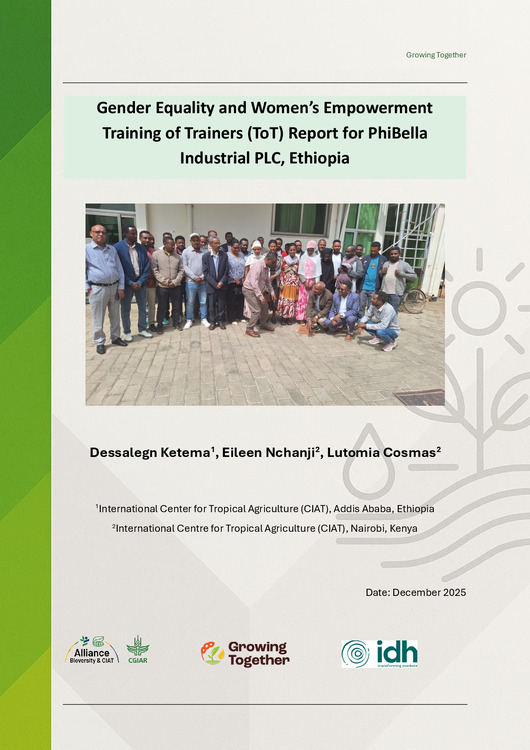
From 27–31 October 2025, the Alliance of Bioversity International and CIAT delivered a Gender Equality and Women’s Empowerment Training of Trainers (ToT) for PhiBella Industrial PLC at Addis Amba Hotel, Bahir Dar, under the NORAD-funded Growing Together Program. The training aimed to strengthen inclusive, climate-smart, and market oriented agri-food systems by ensuring SMEs like PhiBella actively integrate Gender Equality and Social Inclusion (GESI) in their business operations, extension approaches, and supplier engagement within the soybean and sunflower value chains. The training targeted staff and trainers involved in technical support, extension, and decision-making, with a strong emphasis on the ToT cascade model to expand reach to farmers, cooperatives, unions, and local extension systems. A total of 39 participants attended (32 men and 7 women), showing a significant gender imbalance in advanced leadership and technical capacity-building spaces an issue acknowledged as a structural barrier that can affect who becomes visible as trainers, mentors, and value chain leaders. Core sessions clarified key concepts including gender equality, equity, justice, and transformation, stressing that transformation goes beyond numerical representation to address deeper power relations, social norms, and institutional barriers that sustain inequality. Participants reflected on how interventions can unintentionally reinforce inequalities if they do not tackle these root causes. The training also made a strong business and development case for investing in gender equality, noting that gender gaps in access to resources, finance, information, and leadership can reduce productivity, supply reliability, and innovation. Participants examined common gender gaps within SMEs (recruitment, promotion, leadership roles, access to training) and applied the Reach-Benefit-Empower-Transform (RBET) framework to strengthen gender outcomes in SME activities and supplier/extension models. In the final sessions, groups identified concrete entry points for applying GESI within PhiBella’s work (extension services, supplier selection, training cascades, and internal HR practices). Overall, the ToT built a strong foundation for mainstreaming GESI in SME operations and oilseed value chains, but the report stresses that without deliberate efforts to increase women’s inclusion in higher-level training and leadership pipelines, ToT models may reproduce existing inequalities rather than transform them.