
Fast track leadership training guide (One-day condensed curriculum)
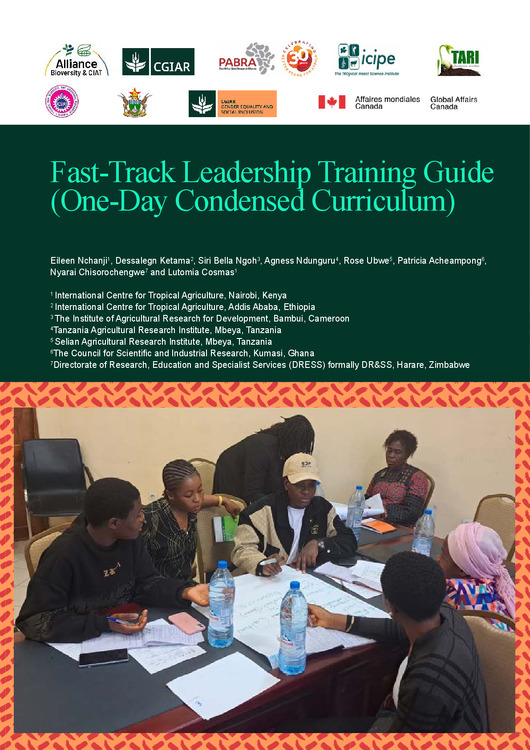
The Fast-Track Leader is a high-impact, one-day training intensive designed to trigger a rapid paradigm shift in community leadership and agricultural governance. It is an accelerated overview covering the essentials of personal leadership, barrier-breaking, and strategic problem-solving in a single day. Rooted firmly in a gender-transformative approach, this curriculum rejects models that ask women and youth to adapt themselves to fit inequitable systems. Instead, it is built to empower them as active economic actors, agents of change, and the primary architects of climate-resilient agricultural systems. The training equips participants with the confidence and strategic tools needed to demand structural redesigns within their communities and cooperatives.
To ensure total accessibility and high engagement across all formal educational backgrounds, the curriculum employs experiential, literacy-neutral adult learning methodologies. Through dynamic visual tools (such as the "Tree of Life") and physical frameworks (like the "Shared Canopy" stance), participants rapidly internalise complex concepts. The fast-paced format relies heavily on interactive role-play, peer-to-peer coaching, and active listening exercises to move learners from theory to practical application within a single day.
Key Training Pillars
• Redefining Leadership Identity: Participants learn to translate their lived agricultural realities and everyday household survival skills into recognised, high-level leadership competencies, actively dismantling internal self-doubt.
• Overcoming Structural Barriers: The training guides advocates in identifying and categorizing personal, social, and structural hurdles. It emphasizes collaborative, cross-gender leadership, proving that community resilience requires the equal partnership and mutual respect of all leaders.
• Strategic Communication & Advocacy: Participants master a concrete, four-part advocacy pitch (Problem, Impact, Solution, Benefits). Through targeted role-play, they practice mapping institutional power and confidently delivering structural demands to local decision-makers.
• Securing Cooperative Representation: Acknowledging the stark disconnect between agricultural labor and boardroom authority, the curriculum guides participants in mapping local cooperative power structures. Advocates align on actionable pathways, such as mandatory quotas and mentorship pipelines, to secure formal influence over finances, seed funding, and market integration.
The intensive deliberately bridges the gap between workshop theory and on-the-ground reality. It concludes with strict accountability: every participant develops a concrete, immediate action plan for their household or cooperative. Furthermore, to drive rapid, systemic scaling across agricultural systems, each participant assumes a direct mandate to act as a change agent, committing to cascade this exact leadership framework by mentoring and coaching 45 additional individuals within their community.