
Farmer preferences for sustainable intensification in silvopastoral systems
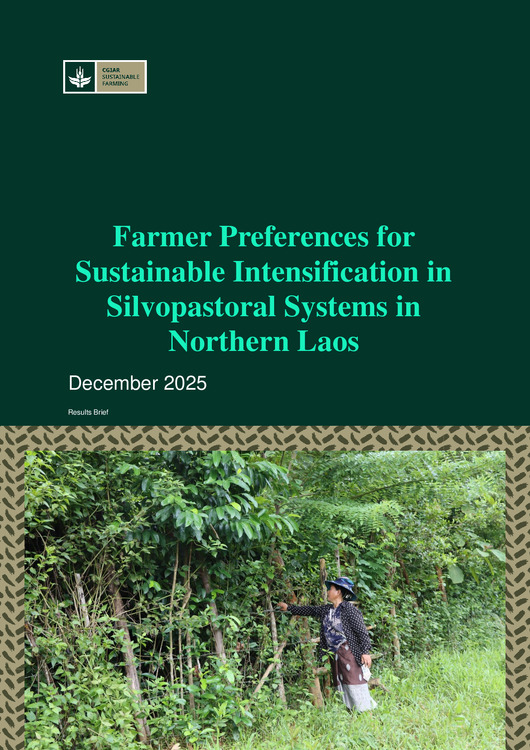
Silvopasture has potential for mitigating livestock production impacts. However, many of its benefits accrue as public goods, which can limit farmer adoption. To overcome these constraints, it is important to understand farmers’ preferences for technology adoption, adoption barriers, and the incentives required.
This Brief reports the results of a choice experiment examining farmer preferences for adopting silvopastoral practices in two districts in Northern Lao PDR: Phonxai (Luang Prabang province), and Nonghet (Xiengkhouang province). The interventions assessed included (i) increased dry season forage availability, (ii) establishment of living fencing, (iii) maintenance of tree density during secondary forest clearance, (iv) riparian zone protection, and (v) full herd disease prevention.
Few farmers selected the status quo alternative in any of their choices, indicating a strong interest in participating in programs that deliver benefits from silvopastoral sustainable intensification. Results also revealed strong farmer interest in improving forage availability and establishing living fencing, and, as expected, a dislike for increased labour requirements. Farmers in Nonghet district required approximately three annual payments of US$235 to achieve a 30% increase in forage availability and about US$515 for at least 90% of fencing to be living fencing.
Overall, the incentives required were both modest and needed only for a limited period. This suggests that once constraints related to initial establishment costs are overcome, the longer-term benefits of sustainable intensification can make silvopastoral practices economically attractive for farmers, while also delivering ecosystem services that benefit society. Given the preferences expressed for increased, high-quality dry season forage, living fencing establishment and maintaining trees during secondary forest clearance, future applied research should focus on improved farmer-led forage experimentation; facilitating access to suitable tree planting materials (for example, through decision-support tools and strengthened nursery systems); and the impacts of higher tree density on pasture growth through seasons. In addition, better approaches are needed to raise farmer awareness of the benefits of livestock disease prevention, addressing logistical constraints, and strategically target interventions to protect riparian zones.
Overall, the choice experiment provided practical evidence to support the identification, design, and targeting of silvopastoral sustainable intensification interventions and associated incentive mechanisms. The study findings informed subsequent implementation of such interventions where 128 households in 2025 planted and protected 10,500 trees of 29 native species as living fences and on pastures, for a total payment for ecosystem services of US$9,528.