
Evaluation of farmer reach and use of climate-adaptive crop and soil advisory system
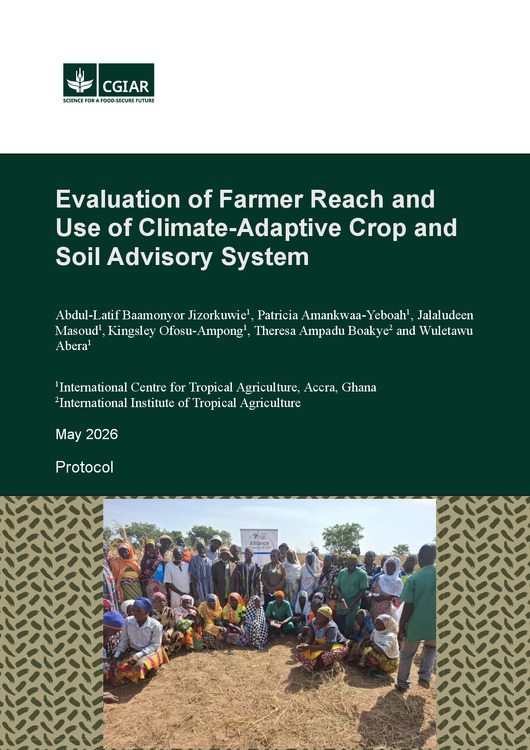
Smallholder farming systems in Ghana are increasingly affected by climate variability, declining soil fertility, untimely agronomic operations, and limited access to localised and climate-responsive extension services. These challenges contribute to low productivity, inefficient input use, and heightened production risks among smallholder farmers, particularly within rainfed agricultural systems of northern Ghana. In response, the Alliance of Bioversity International and CIAT, in collaboration with national partners, developed the Cropping Calendar Advisory Platform to support farmers with location-specific and climate-informed agronomic recommendations on planting windows, fertiliser management, crop establishment, pest and disease management, and other climate-smart production practices. Despite increasing interest in digital agro-advisory systems, limited empirical evidence exists on their effectiveness, usability, inclusiveness, and productivity impacts under real farmer-managed conditions. This protocol outlines a comprehensive field experiment designed to evaluate the application and effectiveness of cropping calendar-based agro-advisory services among smallholder farmers in selected districts of the Northern and Upper West Regions of Ghana. The study will employ a farmer-managed quasi-experimental comparative observational design involving two farmer categories: advisory users receiving and applying cropping calendar recommendations, and comparable non-users operating under similar agroecological and socio-economic conditions without active exposure to the advisory platform. One Agricultural Extension Agent (AEA) will be selected and trained from each participating district to serve as both extension facilitator and field enumerator. Each AEA will recruit advisory users and non-user farmers for season-long monitoring, while a sub-group of intensively monitored advisory users will receive continuous end-to-end advisory follow-up throughout the cropping season. The study integrates agronomic field monitoring, advisory delivery assessment, gender-disaggregated evaluation, farmer perception analysis, and comparative productivity assessment. Data collection will include crop management practices, advisory access and utilisation, implementation of recommended practices, farmer perceptions and satisfaction, gender-related indicators, and crop productivity outcomes. Standardised crop cutting procedures will be conducted at harvest to estimate grain yield in both advisory treatment fields and comparison fields. Comparative analyses will examine differences in agronomic practices, advisory uptake, the extent to which recommendations were implemented, and productivity outcomes between advisory users and non-users, as well as gender-related differences in advisory access, adoption, and benefits. The study is expected to generate robust field-based evidence on the operational effectiveness of cropping calendar agro-advisory services, strengthen climate-smart and gender-responsive extension systems, and provide strategic insights to support scaling and institutional integration of digital agro-advisory platforms for improving smallholder productivity and resilience in Ghana.