
Evaluating multi-benefit strip-cropping systems for climate-resilient agricultural landscapes in Malawi
Soil erosion, land degradation, and declining soil fertility continue to threaten agricultural productivity and food security across Malawi, particularly in sloping landscapes where runoff and soil loss are prevalent. These challenges are expected to intensify under climate change due to increasing rainfall variability and more frequent extreme weather events. While various soil and water conservation technologies have been promoted, their adoption by smallholder farmers has often been constrained by labor requirements, land-use trade-offs, and limited short-term economic benefits. Consequently, there is growing interest in integrated farming approaches that simultaneously enhance productivity, improve resilience, and conserve natural resources.
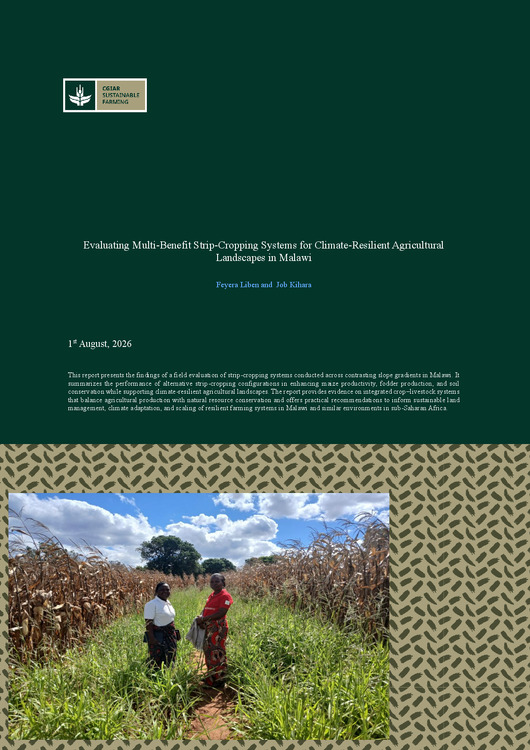
This study evaluated the performance of strip-cropping systems as a strategy for developing resilient agricultural landscapes in Malawi. The approach integrates contour-aligned grass strips with maize and legumes within productive farmland to reduce runoff and erosion while maintaining crop production and generating livestock feed. The study aimed to assess the agronomic, fodder, and conservation potential of alternative strip-cropping configurations across contrasting slope conditions and to identify systems capable of balancing productivity and sustainability objectives.
Field experiments were established on farmer-managed fields representing gentle (5–15%) and steep (15–25%) slope categories. Four cropping systems were evaluated using a randomized complete block design with three replications per farm: (i) Grass–Maize–Grass (GMG), (ii) Grass–Maize–Grass–Maize–Grass (GMGMG), (iii) Grass–Maize–Legume–Maize–Grass (GMLMG), and (iv) a maize monocrop control. Mixed-effects models were used to assess treatment effects while accounting for farmer-to-farmer variability.
Results showed that cropping system significantly influenced maize grain yield and overall system productivity, whereas slope category and treatment × slope interactions were not significant during the first year of evaluation. The Grass–Maize–Grass system consistently achieved the highest maize grain yield, averaging 9.54 t ha⁻¹ across slope categories. This yield was statistically comparable to the maize monocrop control (8.98 t ha⁻¹), demonstrating that allocating approximately 28.6% of land to contour grass strips did not compromise maize production. In contrast, the more intensive strip-cropping systems produced significantly lower maize yields. The Grass–Maize–Grass–Maize–Grass system yielded 7.00 t ha⁻¹, while the Grass–Maize–Legume–Maize–Grass system yielded 6.66 t ha⁻¹.
A similar pattern was observed for system productivity expressed as maize-equivalent yield (MEY). The Grass–Maize–Grass system achieved the highest overall productivity at 10.01 t ha⁻¹, exceeding the maize monocrop control by 11.5%. The two more complex strip-cropping systems recorded lower productivity, averaging 7.71 and 7.77 t ha⁻¹, respectively. These results indicate that moderate allocation of land to grass strips can maintain maize production while generating additional fodder biomass and improving total system output.
The absence of significant slope effects suggests that treatment performance was stable across the evaluated landscape positions. Similarly, the lack of significant treatment × slope interactions indicates that the relative ranking of strip-cropping systems remained consistent across both gentle and steep slopes. This finding is particularly important for scaling because it suggests that the most effective system can be broadly applied across diverse farming landscapes without major adjustments for slope conditions.
The superior performance of the Grass–Maize–Grass system reflects its ability to balance production and conservation objectives. By maintaining a high proportion of land under maize while incorporating strategically positioned grass barriers, the system provides opportunities to reduce runoff and sediment loss, improve water infiltration, and generate livestock feed without sacrificing grain yield. In contrast, systems allocating larger proportions of land to grass or legumes reduced effective maize area and consequently lowered short-term productivity. However, these systems may generate additional long-term benefits through enhanced soil conservation, biological nitrogen fixation, improved nutrient cycling, and increased resilience to climatic stresses.
The findings demonstrate that strip cropping can serve as a practical climate-resilient intensification strategy for Malawi’s mixed crop–livestock systems. Among the configurations evaluated, the Grass–Maize–Grass system emerged as the most promising option for simultaneously enhancing maize productivity, fodder availability, and landscape resilience. The results provide evidence that conservation-oriented farming systems can be integrated into productive land use without imposing significant yield penalties.
Future research should continue monitoring these systems over multiple seasons (3-5 years) and expand testing across additional agroecological zones and slope categories to quantify runoff reduction, sediment retention, soil moisture dynamics, changes in soil fertility, fodder quality, and economic returns. Such information will be essential for fully capturing the long-term benefits of strip cropping and supporting evidence-based recommendations for scaling resilient agricultural landscapes across Malawi and similar environments in sub-Saharan Africa.