
Enhancing CGIAR collaboration: Mainstreaming PABRA’s food corridors approach for better diets and nutrition impacts
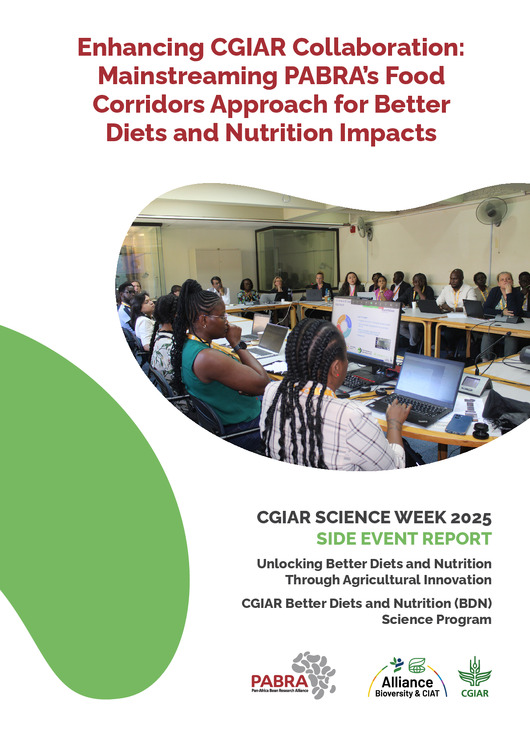
Improving diets is central to achieving certain Sustainable Development Goals (SDGs), addressing malnutrition in all its forms, and linking agriculture, health, gender equity, and climate action. The CGIAR Better Diets and Nutrition (BDN) Science Program embeds diet-centered approaches across its 2030 Research Portfolio, focusing on diverse, nutrient-rich, and safe foods—such as animal-source foods, aquatic foods, cereals, fruits and vegetables, legumes, and roots and tubers. Through integrated food systems research, the program aims to transform agriculture into a driver of improved nutrition. At the CGIAR Science Week 2025 side event, more than 20 stakeholders (see Annex 1) considered how various actors might unlock better diets and nutrition through agricultural innovation, in the context of CGIAR’s Better Diets and Nutrition (BDN) Science Program. They called for stronger cross-center collaboration, implementation of coherent agriculture-to-nutrition strategies, and a community of practice to advance and promote evidence-based action to improve diets. Stakeholders discussed various strategies, including conducting nutrition-sensitive agricultural research, harmonizing MEAL, promoting market and policy engagement, developing and applying value-chain and corridor models, supporting innovation, and scaling context-specific solutions such as homegrown school feeding. A shared commitment emerged to integrate nutrition more systematically across CGIAR research, strengthen internal coherence, and better leverage collective resources to accelerate impact. The Pan-Africa Bean Research Alliance (PABRA)’s Bean Commodity Corridor Model exemplifies this integrated approach—combining demand-led breeding, seed systems, value addition, market-led innovation, and policy integration. Operating in 31 countries and reaching millions of value-chain stakeholders, PABRA offers a scalable, evidence-backed model for translating agricultural research into equitable and sustainable dietary improvements, and helping achieve nutrition-related SDGs across diverse food systems.