
Driving agricultural transformation through women’s empowerment in Kibaigwa flour supplies limited
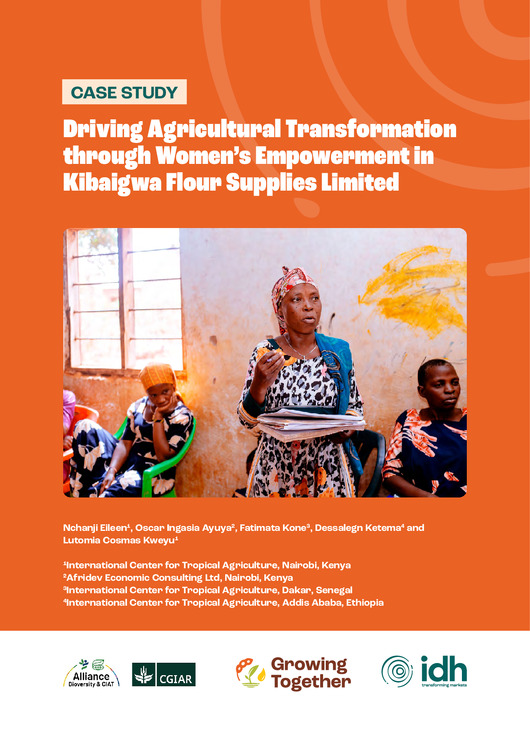
This case study, developed under the Growing Together programme led by IDH and funded
by Norad, and implemented in partnership with CIAT, Rikolto and EAGC in Tanzania
and Ethiopia, examines how a Tanzanian agrifood SME, Kibaigwa Flour Supplies (KFS)
Company Limited, has integrated gender and youth inclusion into its business model while
strengthening commercial performance. Implemented in partnership with CIAT, Rikolto,
and EAGC, the programme seeks to build more competitive, resilient, and inclusive food
value chains by strengthening SMEs’ role in connecting smallholder producers to markets,
services, and investment opportunities.
KFS provides a compelling example of how gender-intentional business practices can
create value for both the enterprise and farming communities. Building on existing
inclusive practices and further strengthened through the Growing Together programme,
the company has embedded women’s participation and leadership across its supply chain.
Women manage 17 of the company’s 28 aggregation centres, and the company only
works with farmer groups that include women in leadership positions. At the governance
level, the board is chaired by a woman, reinforcing inclusion from community to corporate
leadership.
The enterprise complements these institutional measures with targeted support that
addresses barriers faced by women and youth. Through subsidised mechanisation
services and equipment, women and young people access labour-saving technologies at
reduced costs, enabling them to increase farm productivity, reduce labour constraints, and
establish mechanisation-based enterprises that generate additional income. The company
also provides input loans and production support, helping women overcome traditional
constraints in accessing finance and agricultural inputs.
Evidence from KFS demonstrates that gender inclusion is not only socially beneficial but
also commercially advantageous. Women farmers record higher input-loan repayment rates
(97%) than men (82%), while women-managed aggregation centres consistently perform
well in terms of product quality, reliability, operational discipline, and reduced losses. These
outcomes contribute directly to stronger business performance and customer satisfaction.
Market incentives have further accelerated inclusion efforts. Corporate buyers such
as Tanzania Breweries Limited (TBL) require traceable sourcing from women farmers,
particularly to remain focused on the value chains prioritized under the Growing Together
Program. If possible supply chains. Compliance with such requirements has enabled
KFS to strengthen relationships with commercial buyers. The experiences of women and
youth such as Hilda, Zena, and Brighton demonstrate how inclusive business practices
can translate into improved livelihoods, entrepreneurship opportunities, leadership devel
opment, and community-wide benefits. Overall, the case illustrates that when gender
and youth inclusion are embedded within business operations, they can simultaneously
enhance equity, productivity, market competitiveness, and rural transformation.