
From dialogue to delivery: Learning from multistakeholder partnerships in animal and aquatic food systems through Ostrom’s design principles
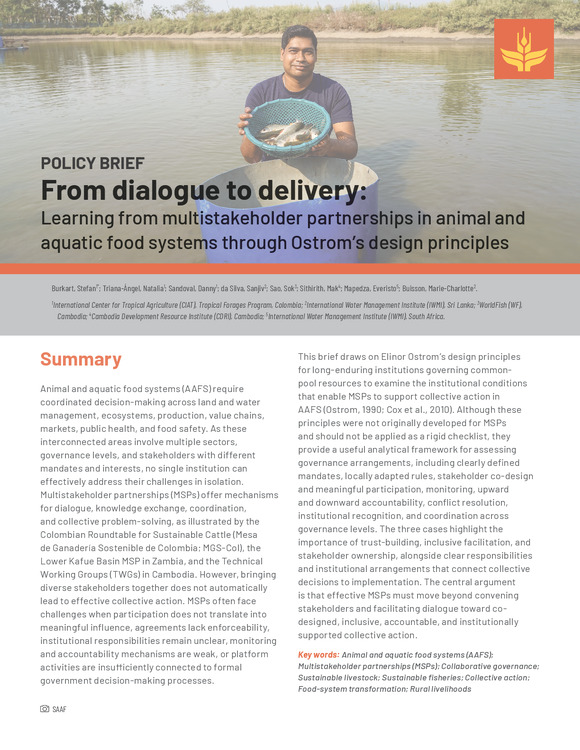
Animal and aquatic food systems (AAFS) require coordinated decision-making across land and water management, ecosystems, production, value chains, markets, public health, and food safety. As these interconnected areas involve multiple sectors, governance levels, and stakeholders with different mandates and interests, no single institution can effectively address their challenges in isolation. Multistakeholder partnerships (MSPs) offer mechanisms for dialogue, knowledge exchange, coordination, and collective problem-solving, as illustrated by the Colombian Roundtable for Sustainable Cattle (Mesa de Ganadería Sostenible de Colombia; MGS-Col), the Lower Kafue Basin MSP in Zambia, and the Technical Working Groups (TWGs) in Cambodia. However, bringing diverse stakeholders together does not automatically lead to effective collective action. MSPs often face challenges when participation does not translate into meaningful influence, agreements lack enforceability, institutional responsibilities remain unclear, monitoring and accountability mechanisms are weak, or platform activities are insufficiently connected to formal government decision-making processes.
This brief draws on Elinor Ostrom’s design principles for long-enduring institutions governing common-pool resources to examine the institutional conditions that enable MSPs to support collective action in AAFS (Ostrom, 1990; Cox et al., 2010). Although these principles were not originally developed for MSPs and should not be applied as a rigid checklist, they provide a useful analytical framework for assessing governance arrangements, including clearly defined mandates, locally adapted rules, stakeholder co-design and meaningful participation, monitoring, upward and downward accountability, conflict resolution, institutional recognition, and coordination across governance levels. The three cases highlight the importance of trust-building, inclusive facilitation, and stakeholder ownership, alongside clear responsibilities and institutional arrangements that connect collective decisions to implementation. The central argument is that effective MSPs must move beyond convening stakeholders and facilitating dialogue toward co-designed, inclusive, accountable, and institutionally supported collective action.