
Designing agri-environmental contracts for traditional orchard meadows. Evidence from a discrete choice experiment on contract attributes, preference heterogeneity and WTA
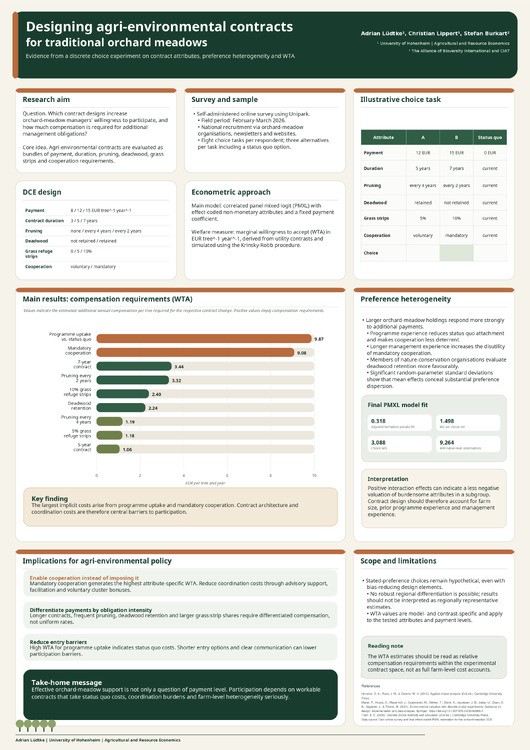
Traditional orchard meadows (Streuobstwiesen) deliver high biodiversity and cultural landscape value, but face continued decline due to ageing tree stocks, management abandonment, labor bottlenecks, and limited economic viability of maintenance. This study develops and performs a discrete choice experiment (DCE) to quantify German orchard managers’ participation trade-offs in conservation contracts and to inform the design of operationally feasible, policy-relevant contractual options. Contract attributes and levels were derived through an integrated evidence strategy combining a systematic literature review and expert/practice interviews, with explicit attention to (i) farm-operational feasibility, (ii) behavioral interpretability using innovation-adoption principles, and (iii) auditability of obligations. The implemented DCE confronted respondents with contract alternatives characterized by six attributes: annual payment (€ tree-1 year-1), contract duration, professional pruning obligation (frequency), deadwood retention, grass refuge strips (area share), and a cooperation requirement, alongside an explicit opt-out option. The final experimental design was generated as a pilot-informed, locally D-efficient design using effect coding and hard restrictions to exclude implausible combinations. To reduce respondent burden, the survey comprised 24 choice tasks blocked into three versions (eight tasks each). The study provides for a transparent, evidence-based pathway from ecological and practice knowledge to survey-implementable contract design and establishes an empirical basis for estimating attribute-level utilities and deriving willingness-to-accept measures for key obligations. Results are intended to support the refinement of orchard meadow agri-environmental schemes by identifying contract features that facilitate participation while safeguarding biodiversity-relevant management outcomes.