
Creating and enacting a Landscape Vision-to-Action (LV2A) in the Lake Victoria Basin: A multi-stakeholder workshop report
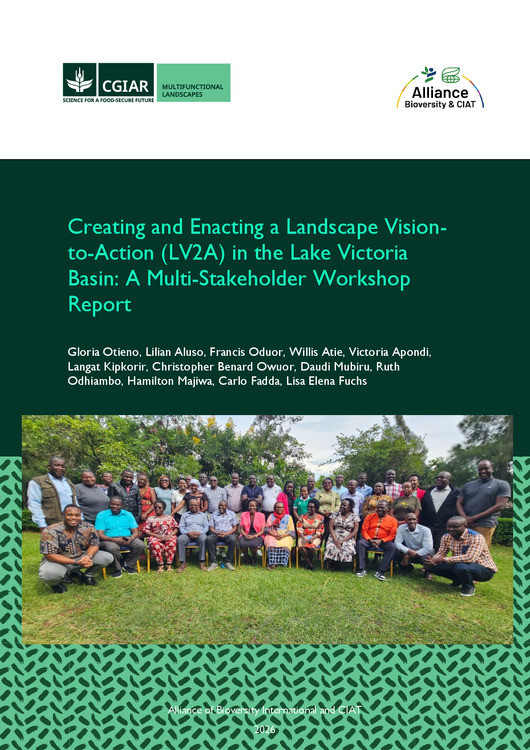
From March 23 to 25, 2026, the team implementing the Biodiversity for Resilient Ecosystems in Agricultural Landscapes (B-REAL) project convened a three-day workshop at Wigot Gardens in Kisumu, bringing county government officials from Kisumu, Vihiga, Kakamega, and Siaya, and Homabay alongside researchers, civil society organizations, farmers, and private sector actors. Their mission was to co-create a shared Landscape Vision-to-Action (LV2A) for the Lake Victoria Basin, a strategic framework to foster coordinated, long-term transformation across the region's agricultural and natural landscapes, which face mounting pressures from land-use change, environmental degradation, and climate variability.
Participants validated the available landscape evidence based on data and identified critical gaps and agreed on priority areas for data improvement, including crop representation, land use information, soil degradation, tree diversity and nutrition related data.
The visioning process resulted in two complementary formulations: the short aspirational version, "A vibrant and resilient Lake Victoria Basin," and the longer scientific version, "A resilient Lake Victoria Basin where multifunctional landscapes support food and nutrition security, biodiversity conservation, ecosystem integrity, and sustainable inclusive livelihoods for present and future generations." The Futures Triangle too was then used to examine the forces shaping movement toward this vision, including weights of the past, pushes of the present, and pulls of the future.
Participants subsequently translated the shared vision into desired future changes and actor-specific behavioral changes across six interconnected domains: climate change, biodiversity, agriculture, soil health and agroecological practices, land management, and water resources. These were used to develop preliminary long-term transition pathways. The pathways should be understood as strategic directions rather than detailed implementation plans and will require further validation, prioritization, assignment of responsibilities, resource mobilization, and measurement. Although the workshop established the core vision, behavioral change and transition pathway components of the LV2A, the metrics and assessment framework was initiated but not finalized during the workshop and was identified as the next critical phase of the LV2A process.
The key results include:
• Shared vision: “A vibrant and resilient Lake Victoria Basin.”
• Substantive vision: A resilient Lake Victoria Basin where multifunctional landscapes support food and nutrition security, biodiversity conservation, ecosystem integrity, and sustainable inclusive livelihoods for present and future generations.
• Six priority transformation domains: climate change, biodiversity, agriculture, soil health and agroecological practices, land management, and water resources.
• Core transformation mechanism: actor-specific behavioral change supported by analysis of enablers, barriers, institutional roles, and incentives.
• Major strategic output: preliminary long-term transition pathways linking priority behavioral changes to sequenced strategic actions.
Critical outstanding component: a co-designed metrics and assessment framework defining indicators, measurement boundaries, timelines, and institutional responsibilities