
Couple training workshop report- Ghana. Building Gender Equitable Resilience for Adaptation to Climate Across Bean Crop and Insect Corridors (BRAINS)
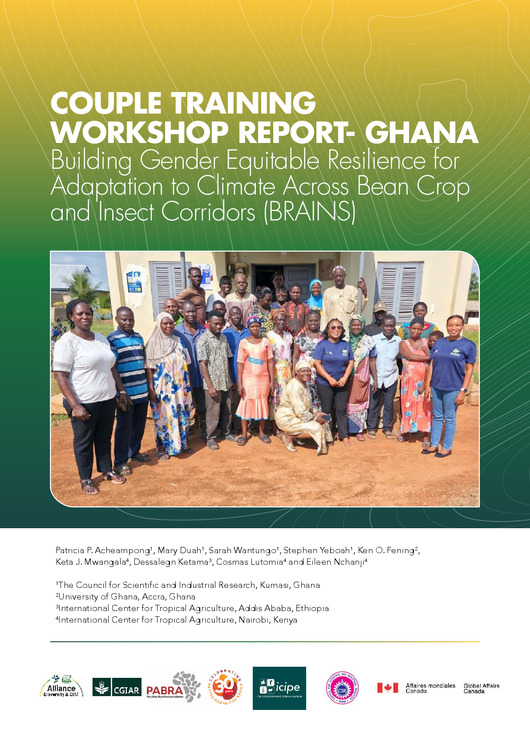
The "Building Gender Equitable Resilience for Adaptation to Climate Across Bean Crop and Insect Corridors (BRAINS)" project organized a one-day training workshop for couples in Ghana. The training's primary objective was to build partnerships among farming households for shared decision-making in agriculture and enterprise. Historically, deeply rooted gender norms have shaped the division of labour and access to resources, often positioning men as the primary decision-makers and limiting women's agency in the agricultural sector. This training aimed at addressing these barriers by helping couples analyze their roles, practice communication skills like active listening, and plan jointly.
The workshop was conducted in the Offinso North district of the Ashanti region and involved 14 couples engaged in smallholder farming and enterprises. The facilitators employed an experiential learning approach that utilized group dialogue, role-playing, and visual tools to encourage practical self-assessment and joint planning.
The training was structured around several interactive modules designed to promote equitable partnerships: Participants engaged in icebreaker and listening exercises to learn how to express themselves clearly and understand the importance of active, empathetic listening without diluting messages. Divided into gender-specific groups, participants created 24-hour activity clocks to visualize and discuss the daily roles and responsibilities of men and women within the home, farm, and community. Couples used voting cards to map out who primarily makes decisions in six key areas: inputs, individual needs, savings, household food, health, and school fees. The voting exercise on household decision-making revealed an evolving pattern of gender roles: Decisions related to finances and livelihoods, such as school fees, inputs, and individual needs, remain predominantly male-dominated. However, there is a substantial shift toward collaboration in areas affecting family well-being; decisions regarding household food and health were predominantly made jointly. Financial management regarding savings showed a mixed pattern, suggesting that while men still lead, it is gradually becoming a more shared activity.
Couples worked as a team to draw a "vision journey" roadmap for their farming business, outlining their current status, future goals (for the next season or up to 2 years), anticipated challenges, and timelines.
Ultimately, the workshop provided valuable insights into existing patterns of household authority and demonstrated how gender-transformative approaches can be practically applied to enhance equity and collaboration in agricultural development.