
Couple training tool: Building Partnerships for shared decision making in agriculture and enterprise
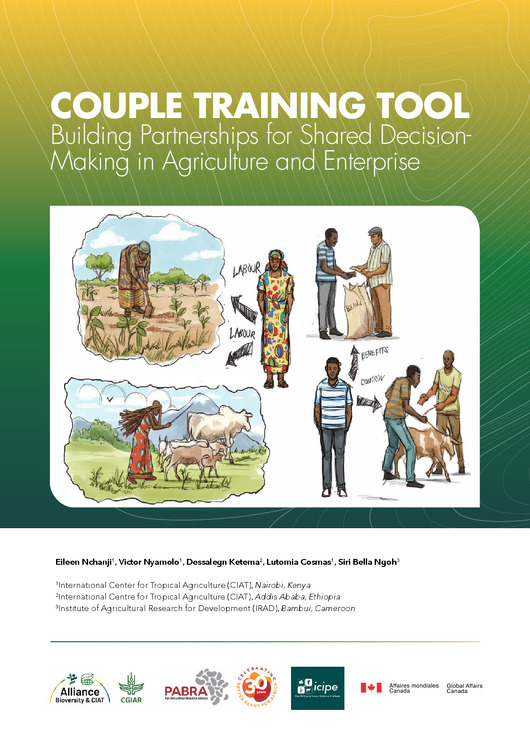
The Couple Training Tool: Building Partnerships for Shared Decision-Making in Agriculture and Enterprise is a
participatory training manual designed to strengthen collaboration between spouses in smallholder farming
and enterprise households. Developed by the Alliance of Bioversity International, CIAT, and partners, the tool
addresses persistent gender inequalities in household decision-making, labour distribution, resource control,
and communication—factors that directly influence agricultural productivity, enterprise performance, household
well-being, and resilience.
The manual provides a structured, practical approach for engaging married couples as joint decision-makers
rather than individual beneficiaries. Its overarching goal is to promote equitable partnerships within households
by improving communication, fostering shared responsibility, and enabling joint planning for agricultural and
enterprise activities. The tool is intended for use by community facilitators, extension agents, NGO staff, and
cooperative leaders working with rural and peri-urban households.
The training is grounded in key principles of respect, neutrality, cultural sensitivity, confidentiality, and inclusive
participation. It emphasises experiential and visual learning methods to ensure accessibility for both literate
and non-literate participants. Activities are delivered through interactive sessions that use drawings, role-plays,
scenario analysis, and group dialogue rather than lectures.
The core training structure consists of six sessions delivered over one or two days, with follow-up visits to support
behaviour change. Sessions guide couples through: (1) building trust and communication skills; (2) analysing
household roles and time use; (3) practising shared decision-making; (4) examining equitable income and benefit
sharing; (5) developing joint agricultural and enterprise plans; and (6) establishing commitments and monitoring
mechanisms. Practical tools such as the Daily Activity Clock, Decision Wheel, Income Pie Chart, Technology Vision
Journey, and Couple Business Canvas help couples visualise current practices and plan for change.
Expected outcomes include improved spousal communication, more equitable labour sharing, increased joint
decision-making, and stronger adoption of agricultural and enterprise innovations. Over time, the approach
contributes to enhanced productivity, reduced household conflict, greater resilience to climate and economic
shocks, and positive role modelling within communities.
Overall, the manual offers a scalable, context-adaptable methodology for advancing gender-equitable household
partnerships as a foundation for inclusive and sustainable agrifood system transformation.