
Couple training report - Siha, Tanzania. Building Gender Equitable Resilience for Adaptation to Climate Across Bean Crop and Insect Corridors (BRAINS)
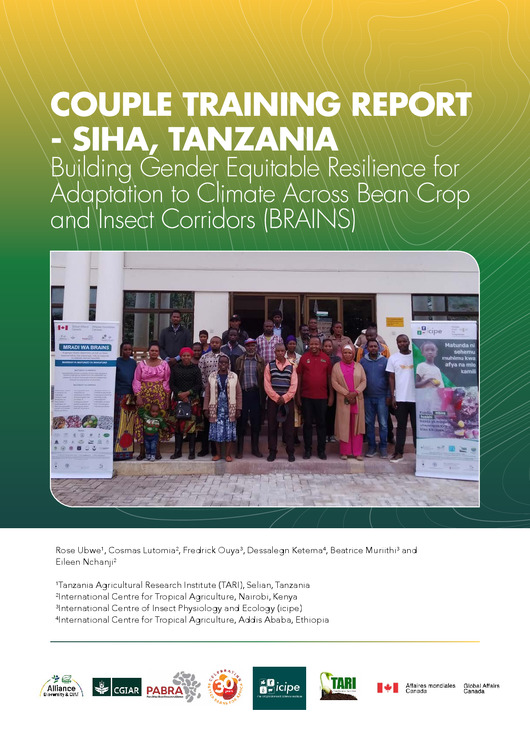
The Couple Training conducted in Siha District, Arusha (23–24 March 2026) under the BRAINS Project (2024
2028) aimed to strengthen household collaboration as a pathway to improved agricultural productivity and
climate resilience. The training addressed persistent gender inequalities in rural farming systems, where
women contribute significant labour but often have limited decision-making power and control over income.
By engaging couples jointly, the intervention promoted more equitable, informed, and coordinated household
decision-making.
A total of 10 couples (20 participants, 50% women and 30% youth) participated in a two-day, participatory
training delivered in Kiswahili using experiential learning methods, including role-playing, visual tools, and group
discussions. The sessions focused on communication, trust-building, understanding the division of labour, joint
decision-making, and shared planning for agriculture and enterprise.
Key findings highlight that poor communication and unequal division of labour remain major constraints to
effective household functioning and adoption of climate-smart practices. Women typically face a “double burden”
of productive and reproductive work, limiting their participation in decision-making. At the same time, men often
control larger but less consistent income streams, while women manage daily household needs through smaller,
more regular earnings. Encouragingly, results showed a strong shift toward joint decision-making in areas such as
health, education, and farm inputs, though gaps persist in financial management and resource allocation.
The training demonstrated that when couples learn together, information gaps narrow, trust improves, and
readiness to adopt agricultural innovations increases. Participants reported high satisfaction with the training, all
indicating that the skills gained would improve household income and cooperation.
Overall, the training confirmed that strengthening intra-household relationships is critical for achieving gender
equity, enhancing technology uptake, and building resilient farming systems. It recommends scaling joint training
approaches, strengthening gender-sensitive extension services, promoting financial literacy, particularly for men
and supporting follow-up mentoring to sustain behavioural change.