
Couple training report - Malawi: Building Equitable Climate-Resilient African Bean & Insect Sectors (Brains)
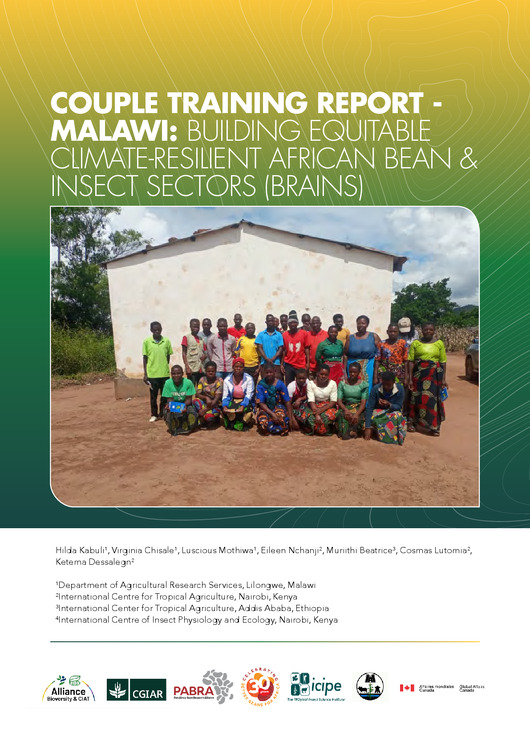
The couple training workshops were conducted under the Building Equitable Climate-Resilient African Bean &
Insect Sectors (BRAINS) project in Malawi. Implemented by the Department of Agricultural Research Services
(DARS) in partnership with Alliance of Bioversity International and CIAT, PABRA, and icipe, the BRAINS project
seeks to strengthen climate resilience, gender equality, and inclusive agricultural transformation across bean,
fruit tree, beekeeping, and insect value chains. The couple training was designed to strengthen household
partnerships, improve communication, promote equitable sharing of roles and resources, and enhance joint
decision-making among farming households.
The training was conducted between April and June 2026 in four districts: Mwanza, Zomba, Rumphi, and Nkhata
Bay. A participatory, learner-centered approach was used, incorporating role plays, group discussions, visual
learning tools, daily and seasonal activity calendars, and household planning exercises. The training reached 72
participants, including 38 men, 34 women, and 19 youth, ensuring broad participation of household decision
makers and future agricultural leaders.
The sessions focused on five key areas: building trust and communication, understanding gender roles and
responsibilities, strengthening household decision-making, promoting equitable benefit and resource sharing,
and supporting joint household planning. Through practical exercises, couples reflected on the unequal
distribution of unpaid care and domestic work, the importance of active listening and respectful communication,
and the benefits of making decisions jointly on issues such as income use, crop production, education, and
household expenditures. Participants also explored how equitable sharing of responsibilities and resources can
contribute to improved family harmony, productivity, and household well-being.
The joint planning sessions enabled couples to develop shared visions for their families and enterprises using
tools such as challenge-action trees, business canvases, and vision road maps. These exercises helped participants
identify their aspirations, resources, opportunities, and action steps required to achieve long-term household
and agricultural goals.
Post-training evaluation results indicated strong commitment to applying the lessons learned. Among the 35
participants who completed the evaluation, 94.3% committed to planning farming activities together, 57.1%
pledged to discuss financial decisions jointly, 51.4% committed to listening more actively to their partners,
and 48.6% planned to share household chores more equitably. These findings demonstrate that the training
successfully promoted behavioural intentions toward greater collaboration, communication, and joint planning
within households.
Overall, the couple training contributed to the BRAINS project’s gender-transformative agenda by equipping
farming households with practical skills and tools to foster equitable relationships, strengthen decision-making,
improve resource sharing, and advance climate-resilient agricultural livelihoods. The training laid an important
foundation for enhanced household well-being, improved productivity, and more inclusive participation of
women, men, and youth in Malawi’s agricultural transformation.