
Couple training report – Cameroon. Building Gender Equitable Resilience for Adaptation to Climate Across Bean Crop and Insect Corridors (BRAINS)
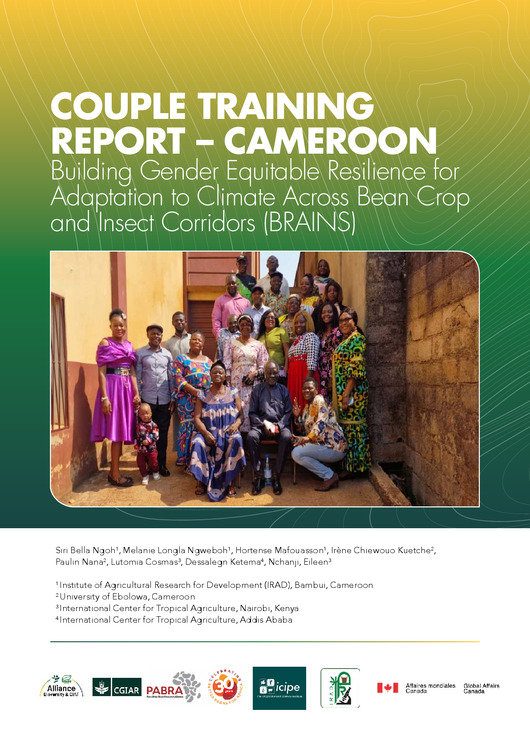
The Alliance of Bioversity International and CIAT (Alliance), in partnership with the Pan-Africa Bean Research Alliance (PABRA), the International Centre of Insect Physiology and Ecology (ICIPE), the Institute of Agricultural Research for Development (IRAD), and the University of Ebolowa, organised a specialised workshop in Bafoussam, West Region, Cameroon, on March 2nd–3rd, 2026. This training was a component of the BRAINS Project, funded by Global Affairs Canada.
The specialised training workshop targeted couples within agricultural households. The central goal was to enhance cooperation between partners to simultaneously improve farm productivity, advance gender equity, and elevate overall family well-being. The workshop reframed farming as a shared business venture, strengthening both marital relationships and agricultural livelihoods through joint planning, improved communication, mutual financial management, conflict resolution, and the equitable division of labour.
The two-day workshop, held at Saint Xavier Catholic Church Hall in Koptchou, utilized participatory approaches, interactive exercises, and materials such as flip charts and markers. There were 25 attendees, including the core target of 10 farming couples and supporting staff from partner institutions. All participating couples are involved in food-crop farming, while many also engage in fruit-tree production and beekeeping. The demographic profile was gender-balanced (14 women, 10 men) and predominantly older than 35, with specific consideration given to youth (under 35) and participants living with disabilities.
The workshop was structured around hands-on exercises designed to develop practical skills:
Understanding Roles & Responsibilities: Participants mapped daily activities to optimise time management and productivity. While gender-based labour divisions differ across family and societal levels, the analysis (Table 2) showed that while both genders engage in similar productive work (approx. 8 hrs/day), women carry a disproportionately larger burden of unpaid domestic and care responsibilities. Men spend more time on formal work and personal activities, resulting in a "double burden" and limited leisure time for women.
Decision-Making Exercise: Couples used a structured simulation to visualise how decisions are made across five critical domains. The results showed that decisions regarding social welfare (Family Health, Children's Education, and Daily Diet) are predominantly collaborative, with high percentages of joint decision-making (75%, 65%, and 60%, respectively). Conversely, economic and production domains favour masculine control, particularly regarding the purchase of agricultural inputs (65% husband-led). Sales and marketing exhibited a complex dynamic, leaning slightly toward masculine control (45%) over joint decisions (40%).
Communication Exercises: Two core activities tested and demonstrated the dynamics of effective messaging.
"Back-to-Back Drawing" exercise illustrated that a substantial disconnect often exists between verbal descriptions and practical understanding, requiring repetition, active listening, and avoiding assumptions for clear communication.
"Listening Circle" structured tool documented message alteration over transmission lines, noting that deformations occur as messages pass through sequences, summarising and rephrasing along the line, with distortion increasing as group size increases.
Joint Planning Journey: Couples engaged in strategic planning for a collaborative household enterprise. Goals were structured into Specific, Measurable, Action-oriented, Realistic, and Time-bound (SMART) activities, breaking yearly Specific actions into a measurable action plan to reduce drudgery, optimise production, increase family income, and elevate living standards. An example of the FOGHE Vincent family was used to illustrate, establishing their current bean production (500kg/ha) and mapping a vision (1.5 tons by 2028), identifying opportunities (land, seeds, manure), and defining challenges (climate change, good agronomic practices) and activities to achieve it.
Eighteen participants completed the post-training evaluation, showing balanced male and female representation. All respondents believe the training language was easy for both men and women to understand. Feedback was very positive, with 16 respondents rating the training as very helpful and 2 as extremely helpful. All women and 7 of 9 men believed the skills would increase household income. Participant’s confidence in using the knowledge is high, both individually and as couples. Action commitments were strongest around joint farm-season planning (selected equally by men and women), and money discussions (selected by most respondents).
The workshop concluded with a distribution of seeds to couples as an award for their brilliant and active participation, including FeB 192 and RWR varieties. A follow-up to provide supervision and evaluate the training’s impact is scheduled for three months, with a later follow-up at six months, by IRAD colleagues. The workshop successfully initiated the social transformation process required for sustainable agricultural advancement, empowering couples to collaborate effectively, strengthen household decision-making, and cultivate more productive, inclusive, and sustainable agricultural systems.