
Comprehensive guide to co-designing gender-transformative socio-technical innovation bundles through farmer cooperatives for inclusive agricultural transformation in Uganda
Agriculture remains central to Uganda’s economy,
food security, and rural livelihoods, with smallholder
farmers contributing significantly to national
agricultural production. However, farming systems
continue to face persistent challenges, including
limited access to quality inputs, weak market
integration, climate variability, post-harvest losses,
and entrenched gender and social inequalities.
Women and youth are major contributors to
agricultural production, yet they often experience
unequal access to land, finance, extension services,
technologies, markets, and leadership opportunities.
These constraints reduce their ability to fully
participate in and benefit from agricultural innovation
and climate-resilient development pathways.
This guide presents a practical framework
for co-designing and implementing Gender
Transformative Socio-Technical Innovation Bundles
(GTSTIBs) through Uganda’s Farmer Cooperatives
(FC) model under the Building Equitable Climate
Resilient African Bean and Insect Sectors (BRAINS)
project. It integrates technological innovations,
technical skills, and social innovations to address
barriers to productivity, inclusion, and resilience.
Beyond technology dissemination, the framework
recognises that innovation adoption is strongly
shaped by behavioural, institutional, and socio
cultural dynamics within agricultural systems.
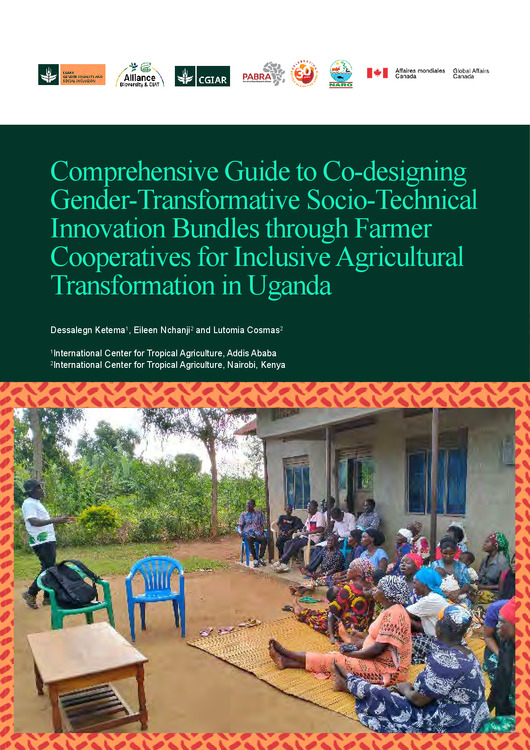
The FC model functions as a community-owned
innovation platform where women and youth act
as seed entrepreneurs, extension champions,
facilitators, and agribusiness leaders. Through
participatory co-design processes, communities,
researchers, extension systems, private sector
actors, local governments, and farmer organisations
jointly identify challenges, prioritise solutions, and
shape implementation pathways. This process
strengthens local ownership, accountability, trust,
and sustainability while ensuring interventions
remain responsive to local realities and power
relations.
A key feature of the guide is integrating Social and
Behaviour Change (SBC) approaches to address
restrictive gender norms, unequal decision-making,
low technology trust, and barriers to adoption.
Community dialogues, peer learning, demonstration
plots, local media, and mentorship promote inclusive
participation, strengthen women’s and youth’s
Brief
agency, and support climate-resilient agricultural
transformation. The guide emphasizes multi
stakeholder partnerships and adaptive Monitoring,
Evaluation, and Learning (MEL) systems. Linking
innovation hubs with research, extension, financial
services, and markets provides a pathway for
inclusive, resilient, locally driven agricultural
innovation systems in Uganda.For the phased
expansion and institutionalisation of this approach
across value chains and districts, this guide should
be read alongside the Uganda Youth and Women
Quality Centre (YWQC) Scaling Roadmap here
after called ‘Scaling Roadmap’ which sets out
sequenced short, medium-, and long-term actions,
implementation responsibilities, and indicators for
scaling.