
Co-designing Ghana's Partnership for Advancing Agricultural Solutions at Scale (PAASS): A systems approach to agricultural innovation and scaling
Agricultural transformation increasingly depends on the effective generation, management, and use of data to support research, policy, extension, and investment decisions. Ghana possesses extensive agricultural datasets generated by research institutions, universities, government agencies, development partners, and the private sector. However, these datasets remain dispersed across institutions, managed using different standards, and stored in disconnected systems, limiting data sharing, interoperability, and their application in digital agriculture and evidence-based decision-making.
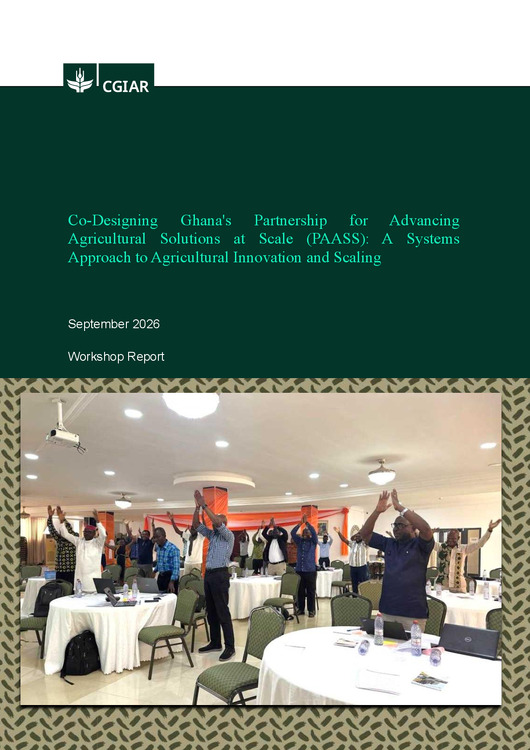
To address these challenges, the Alliance of Bioversity International and CIAT, in partnership with the International Institute of Tropical Agriculture (IITA), convened the Agricultural Data Sharing and Interoperability Workshop under the Partnership for Advancing Agricultural Solutions at Scale (PAASS). The workshop brought together stakeholders from research, academia, government, development partners, and the private sector to develop a shared approach to strengthening agricultural data governance and interoperability in Ghana.
The workshop established that the principal challenge is not the availability of agricultural data, but the absence of coordinated governance, harmonised standards, and institutional mechanisms that enable data to be shared, integrated, and reused across organisations. Strengthening data governance, adopting common standards, improving interoperability, and investing in digital infrastructure were identified as priorities for building an integrated national agricultural data ecosystem.
A key outcome of the workshop was the establishment of the Coalition of the Willing – Ghana Chapter under PAASS to coordinate institutional collaboration, technical exchange, and implementation of agreed actions. The workshop also reaffirmed the central role of the National Agricultural Research System, universities, and government institutions in generating, managing, and applying agricultural data to support research, digital advisory services, climate-smart agriculture, and innovation scaling.
The workshop concluded that Ghana has the institutional capacity and technical expertise required to establish a coordinated agricultural data ecosystem. The immediate priority is to strengthen governance arrangements, harmonise data standards, and improve interoperability to enable existing datasets to support agricultural research, digital innovation, and evidence-based decision-making.