
Building Equitable Climate-Resilient African Bean & Insect Sectors (BRAINS) Project - Zambia baseline survey report
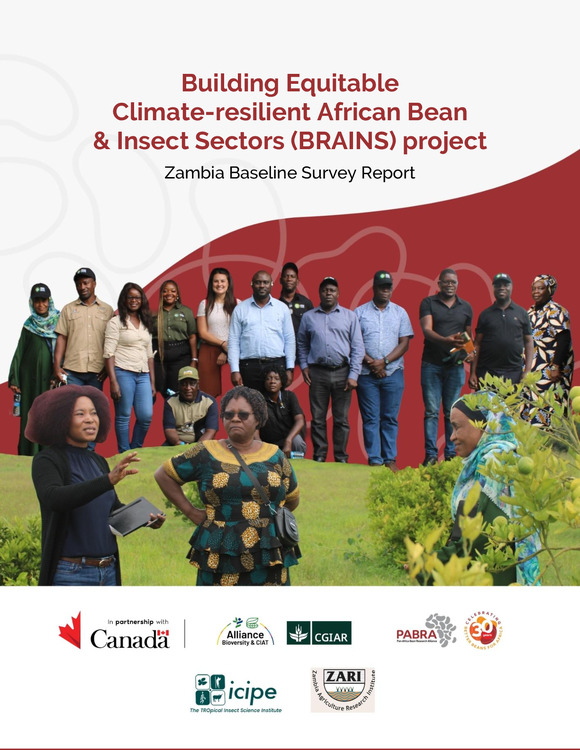
This study investigated household-level knowledge, practices, and challenges related to climate change adaptation and sustainable livelihoods in six provinces: Eastern, Lusaka, Central, Luapula, Muchinga, and Northern provinces in Zambia. Data was collected from 575 household heads from eighteen (18) different camps across the study area, using a structured questionnaire administered through SurveyCTO. The data was then analyzed using STATA software. The age of the household heads ranged between 43.09 and 55.30 years, with a household size of 6 - 8 members. Household heads were predominantly males [83.48%] and were monogamously married [>77.39%]. Most household heads had attained secondary and primary school education. The respondents were predominantly protestants [69.04%] and Catholics [30.09%].
The average land ownership size across various provinces is 5.76 hectares, and 88.87% of the households relied largely on their agricultural produce for income generation. An average of 91.83% of the households interviewed had access to mobile phones, while 17.04% lived with disabled family members. Only 11.04% of male and 6.32% of female households received training in agro-weather information. Across the provinces, 58.57% of the female-headed households adopted modern bean seed varieties as innovative bundles compared to their male [55.77%] counterparts. Many households in Lusaka, Northern, and Eastern provinces adopted and cultivated the improved bean varieties with a higher preference for red-mottled, white, and purple. Both men and women household heads primarily obtained their bean seeds from the Agro dealers and the National Research Organization. The primary motivation for planting beans across these provinces was purposefully for the local market and home consumption. Most of the respondents [>75%] reported increased insect pest infestations, higher disease incidences and long dry spells [drought] as production challenges experienced. The primary buyers of beans were local traders from within the province and households, accounting for 77.78% and 26.98%, respectively, of all purchases.
Crop rotation (83.95%) and soil conservation (20.85%) were the most sustainable agricultural practices undertaken in bean plots. For fruit trees [avocado, mango and citrus], among the age groups, agroforestry was widely used by male and female respondents. The primary motivation for growing fruit trees in all the provinces was to target sales at the local market and household consumption. Considerable post-harvest avocado, mango and citrus losses were observed across the provinces due to pests, diseases, and climate challenges. Bee farmers in Muchinga and Lusaka provinces largely used modern beehives, unlike their counterparts in Central and Eastern provinces, who depended on local hives. Further, 61.22% of the farmers across the provinces knew that they needed pollinators to enhance the productivity of their fruit trees, but only 14.78% have noticed an increase in pollinator abundance. Knowledge of the use of insects as food sources was extremely high between the female [73.85%] and male [70.79%] respondents, while < 22% of farmers used insects as feed. Consumers' use of these insects for food and feed varied significantly across the provinces, with mopane worms ranked top.
The NGOs, formal lenders, and group-based microfinance were the most common credit sources, and only 23.83, 22.09 and 21.04% of the farmers had access to loads from these institutions, respectively. Further, only the group-based microfinance institutions had a more balanced approach, significantly offering cash and in-kind credit to the farming communities. Group-based microfinance institutions and informal lenders were the most accessible, within walking distance from the farming communities. The decision to source and use income was made jointly by spouses. Farmers also made substantial average income from diversified sources like remittances, salaried employment, businesses and sales of non-agricultural assets. In-kind contributions were mostly from businesses, salaried employment and remittances. On-farm and off-farm casual labour, sales from
charcoal/bricks and interest were additional options for generating income in the farming communities. The men were primarily responsible for deciding how the income generated from the various sources was used, except for income from land rental, renting of agricultural tools and remittances, which required joint decisions from both spouses. Over 65% of the respondents participated in input supply/farm cooperative groups, particularly in the Muchinga [78.02%], Northern [76.84%] and Central [76.53%] provinces. The respondents with leadership positions in savings and credit groups primarily seek 63.06% of their financial aid from external support compared to 58.62% for merry-go-round groups. Less than 4% of the adult and youth respondents knew about the carbon payment market and the benefits of climate/carbon payments.
Approximately 88.70% of the households were categorized within the 6-12 food groups, indicating high dietary diversity. The male and female-headed households achieved 71.88 and 74.74% food consumption scores, demonstrating that they had a favourable attitude toward dietary practice, and only 3% of the households were food insecure. These findings highlight the imperative requirement for policies and programs to support vulnerable farmers with limited farmland, essential for unravelling the spectrum of nutrition at the household level and beyond.