
Assessing the cost effectiveness and adoption of digital climate advisory services for rice farmers in Myanmar
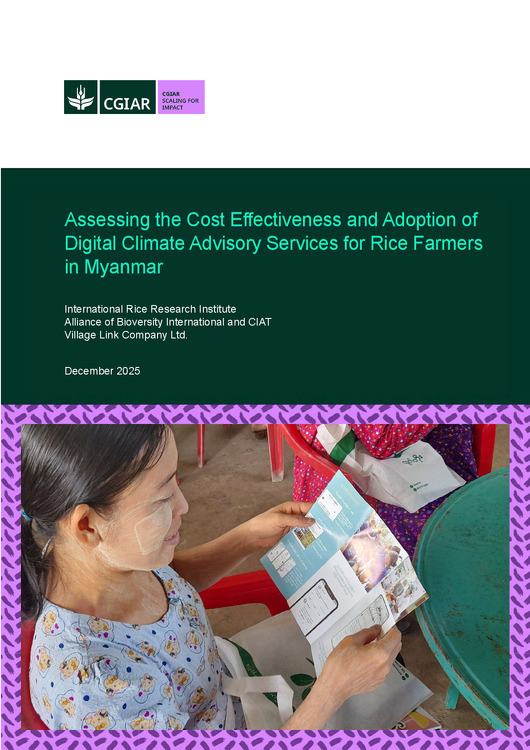
This report presents a study on the adoption of and returns on investment of the Htwet Toe (HT) application, a digital climate advisory service (DCAS) of Village Link Company Limited (Village Link) in Myanmar, which has been active since 2018. The study was initiated by the Alliance of Bioversity International and CIAT in collaboration with the International Rice Research Institute (IRRI) and Village Link, with support of the CGIAR Initiative on Asian Mega-Deltas and the CGIAR Scaling for Impact Program. A survey was conducted among 484 rice farmers in six townships in Ayeyarwady Region, where 243 were from areas exposed to the HT app (treatment) and 241 were from areas that were not yet exposed to the HT app (control). The survey covered socio-demographic information, farm characteristics, exposure to different climate hazards, farming activities and the corresponding expenses in the main plot, awareness and knowledge of HT channels and other DCAS applications, and use of HT channels. From the data collected, factors influencing farmers’ adoption of climate advisories and recommendations through the HT app were determined using a standard Probit model, while the cost-effectiveness of the application was calculated using the economic surplus analysis. Eighty farmers surveyed in the control township of Thapaung in Pathein district practiced the Yae Kya Nauk system. These farmers were excluded from the cost-and-returns analysis due to unconventional practice (i.e., modified cropping calendar). The provision of DCAS through the HT app is an economically viable undertaking that effectively supports climate resilience among rice farmers in the Ayeyarwady Region of Myanmar. The provision of timely, accurate, and locally relevant climate information and advisories is likely to be followed by farmers with access to credit as they gain additional capital enabling them to follow recommended practices. The adoption of climate advisories and recommended adaptation strategies led to higher yield and income with minimal production losses. With this, expanding adoption in the Ayeyarwady Region and beyond, along with targeted interventions to boost farmer yields, are recommended to maximize value and mitigate the impact of climate change.